Meloni's attack on the EU: "It must do less and better; we must defend ourselves from the crisis."
For the Prime Minister, who is proposing a project to reform the bureaucracy, the Union is a "fragile" giant in global dynamics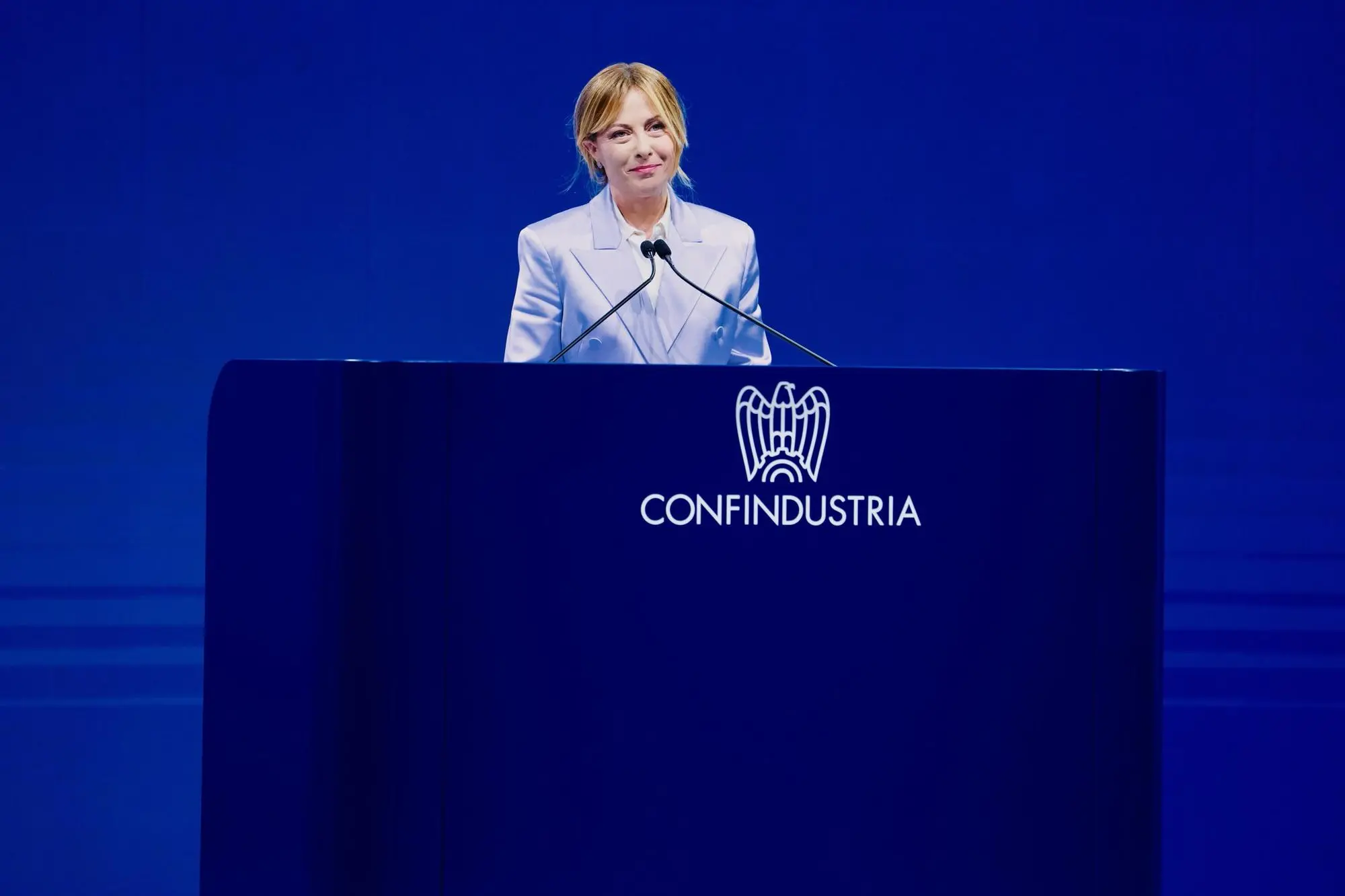
Per restare aggiornato entra nel nostro canale Whatsapp
The EU must "do less and better" and stop being "a bureaucratic giant ." It must guarantee Italy the same flexibility in energy investments as it has for military spending, because "defense is freedom, but today we must defend families and businesses" from the effects of the Iranian crisis. Giorgia Meloni spoke at the Confindustria assembly in Rome, but her attacks were aimed at Brussels, which will respond to her letter to Ursula von der Leyen in a few days—perhaps June 3. Meanwhile, she proposed to businesses "immediately launch a joint project to achieve a common reform of Italian bureaucracy," urging their managers "not to be afraid": "Be brave, and I promise you I will do the same."
The prime minister spoke from the stage for 36 minutes, and some passages, in the aftermath of the local elections with which the center-right hopes to have definitively cushioned the referendum debacle, are not coincidental. Her government, she assures, has not lost its way, "it is here and does not intend to retreat even a millimeter." The audience is friendly, even though there has been no shortage of discussions in recent years, "without prejudice, without discounts, with frankness," Meloni recalls, thanking President Emanuele Orsini "for recognizing the government's efforts to put jobs, business, and production back at the center." A year ago, before the assembly of industrialists, the main issues were more or less the same: energy prices, with the announcement of zero tolerance for speculation, and Europe, which Meloni urged to remove self-imposed internal tariffs.
The situation, however, is now even more critical. It's a time of "multi-crisis," the Prime Minister likes to repeat. The evolution depends largely on Donald Trump , but no one mentions him directly from the stage at the La Nuvola conference center. The Prime Minister notes only that "in the most difficult year for transatlantic relations," exports to the US increased "by 7.2%." This figure helps her assert that " we are no longer Europe's weak link " but a "credible, authoritative" nation. For the Prime Minister, "the main, enormous, weakness" is "the structure of the European Union," which "multiplies rules on every aspect of common life" but is "hesitant when it comes to making its voice heard in global dynamics." She recalls the effort she launched with German Chancellor Friedrich Merz to "clear the regulatory jungle," because "bureaucracy cannot replace politics."
But the standoff with Brussels is now primarily over the request for flexibility in energy cost measures, "to mitigate the impact the closure of the Strait of Hormuz is having on our families and businesses." These are circumstances "beyond the control of EU member states and which, in our view, amply justify" extending the scope of the National Escape Clause. This doesn't mean, Meloni reiterates, "new debt," but "optimizing the allocation of what is already foreseen. Pure and simple common sense."
The prime minister also relaunched the battle over ETSs , and on the Italian front, "the resumption of nuclear production is a goal within our reach." She wants to "proceed expeditiously," "the enabling law will be approved by the summer," and points to "safe, clean, modular mini-reactors" as a benchmark. Representing a series of measures, from the employment decree to the housing plan, Meloni then made a series of overtures to Confindustria's demands: on hyper-depreciation, the reorganization of tax expenditures, the reform of corporate responsibility, the revitalization of individual savings plans, mechanisms to increase pension fund investments in the real economy, and training young people in artificial intelligence.
(Unioneonline)