

Meloni: "Trump's Russian diesel deal is risky." Then she attacked Conte: "With the new electoral law, you wouldn't have become prime minister."
The Prime Minister's remarks to the Senate ahead of the European Council: "Always on Ukraine's side, the surrender of those defending their freedom is not peace."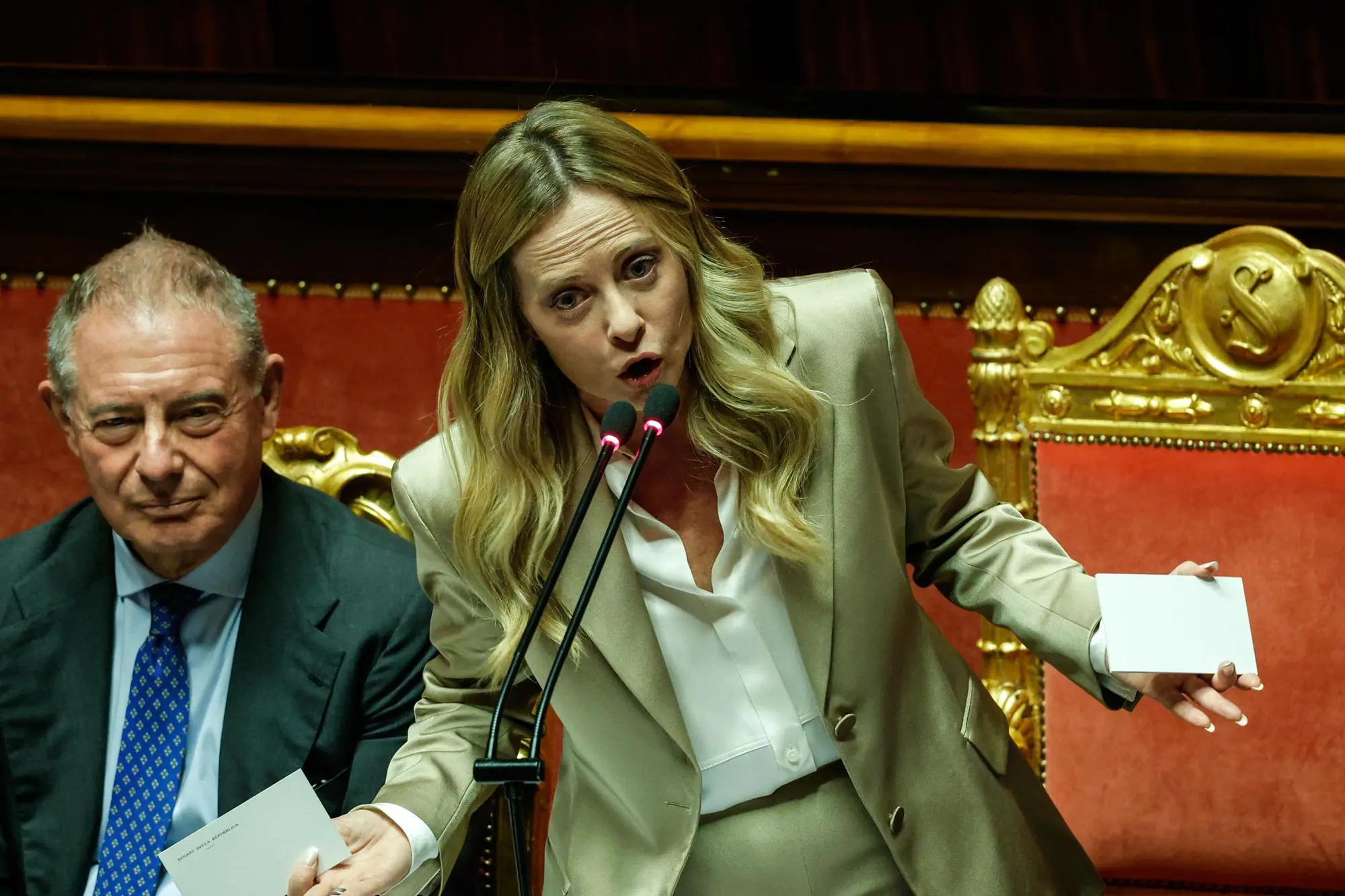
(Ansa-Lami)
Per restare aggiornato entra nel nostro canale Whatsapp
"The agreement on Russian diesel announced last Friday by US President Donald Trump is a choice I consider very risky." Thus Giorgia Meloni, during her remarks to the Senate ahead of the European Council, highlighted the dangers of the Trump-Putin pact, emphasizing that the surge in fuel prices "is primarily due to the war in Iran, not the conflict in Ukraine."
Therefore, the prime minister argues, "the outcome of this choice is uncertain, while the risks are clear. A legitimacy for Moscow while its bombs continue to fall on Ukrainian cities, new revenues with which to finance the war, an implicit weakening of sanctions leverage are elements we cannot ignore, and which contradict everything Western states, including the United States, have done so far to push Putin to the negotiating table."
Again on Ukraine: "No one will convince me that the surrender of those defending their freedom can be called peace. Only a just peace can last and safeguard Europe and our interests. The government's position, therefore, remains unchanged. Support for Kiev, with particular attention to the civilian population, pressure on Moscow, and Euro-Atlantic unity remain the cornerstones of our action."
Economy
Energy costs, Meloni added, are "the issue that weighs most heavily on our economy today, but no one can respond effectively alone; a coordinated and rapid response is needed." This response must be international, but also European: "We must ensure," she sent a message to Brussels, "that rules designed in a context completely different from the one we are experiencing today do not end up exacerbating the effects of the crises we are experiencing."
The E3 format for peace in Ukraine and Renzi's criticisms
"If France, Germany, and Great Britain, in the famous E3 format, believe they can do better alone than we can all do together—and that's what they've done so far—then at least they should do it on behalf of everyone and with an official mandate from everyone," the Prime Minister said, reiterating that Europe "must not stand by and watch" and must "identify an authoritative figure, with a mandate from everyone, capable of bringing the EU's voice to the table."
This point has been criticized by Matteo Renzi: "The E3 format is not good; E2, that is, France and Germany, might be fine because they have a historical relationship. But the E3 format of all the European G7 countries except Italy is unacceptable at any level," the leader of Italia Viva lashed out.
Electoral law and attack on M5S
"If you like preferences so much, why didn't you put them in place when you were in government? The reason you're angry about the electoral law is clear: with this law, citizens choose, and you have to declare your alliances, your prime ministerial candidate, and your platform before going to the polls. I understand your difficulty," Meloni said in response to comments from some Five Star Movement members. "Besides," she added, referring to Giuseppe Conte, "your party is led by a gentleman who, if these rules had been in place before, would never have reached the Presidency of the Council of Ministers."
The vote
The Senate approved the resolutions presented by the majority on the prime minister's communications. The first document, which covers several key issues at the heart of the EU Council, received 104 votes in favor, 61 against, and four abstentions. The second resolution, focusing on Ukraine, received 108 yes votes, one vote against, and two abstentions. This indicates that the opposition did not participate in the vote, dissenting from the double-motion method—as announced shortly beforehand in the chamber—after having specifically requested that the second resolution be absorbed by the first, as it overlaps in part due to commitments regarding Kiev.
The other five documents proposed individually by the opposition forces are therefore precluded. The Democratic Party and the Five Star Movement had split, presenting two separate motions on Ukraine.
