

Genoveffa Yvonne Manca di Villahermosa: the Sardinian who led Bocconi
From Cagliari to Milan, a woman who transformed a family legacy into an institution destined for the future.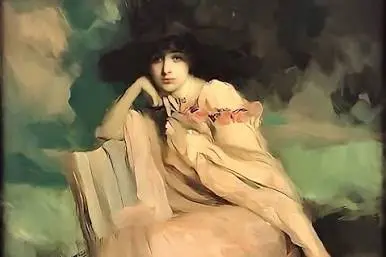
Per restare aggiornato entra nel nostro canale Whatsapp
Genoveffa Yvonne Manca di Villahermosa, known to all as Javotte, was born in Cagliari on October 8, 1879, to one of the most important families of the island's aristocracy. She became the woman who, for over twenty-five years, governed one of Europe's greatest cultural and economic institutions. She was not a soft-spoken woman. She was a powerful woman.
Not all legacies are measured in money. There are families who build fortunes. And there are people who understand that fortunes alone are not enough. Javotte Manca di Villahermosa belongs to this second category. A story that begins in Cagliari and reaches the heart of Italy's most important cities, without fanfare, without politics. With something rarer: the ability to transform a private inheritance into a legacy destined to survive generations.
To understand it, we need to start from afar. From two brothers who weren't nobles. They were merchants.
The Bocconi brothers and the birth of a fortune
When Ferdinando and Luigi Bocconi began their business in Milan, unified Italy was only a few years old. They possessed no aristocratic titles. But they had a rare quality: they understood before anyone else how the world was changing. They observed Paris and London, and understood that modern commerce could not be achieved by small shops alone. In 1877, they opened "Alle Città d'Italia," the first true Italian department store: clearly displayed prices, a vast selection, and a modern organization. A revolution. The foundations of what would become La Rinascente—the name chosen in 1917 by Gabriele D'Annunzio for Cavalier Borletti, who took over the Bocconi business.
Adua: when a pain generates a university
In 1896, Luigi Bocconi, Ferdinando's son, died during the tragic Battle of Adwa. Many would have responded by erecting a monument. Ferdinando chose a different path: to transform his grief into a future. In 1902, the Luigi Bocconi University was founded—a university born from the transformation of a private legacy into a collective good. An idea that would be brought to fruition, thirty years later, by Javotte himself. "She wasn't necessarily a warm woman. But she was a very powerful woman."
A powerful woman in a man's world
Daughter of Don Giuseppe Manca di Villahermosa and Donna Clara Sanjust—two of the oldest families of the Sardinian aristocracy—Javotte married Ettore Bocconi, Ferdinando's second son, and entered one of the most influential families in industrial Italy. The memories of Giada Manca di Villahermosa—Javotte's niece, daughter of her brother Gaetano, and perhaps the last person still able to provide a direct family memory of her—paint the portrait of an imposing, almost regal figure. A woman accustomed to being listened to and obeyed. Authoritarian, aware of her role, capable of being difficult in family relationships. But it is precisely these traits—that toughness, that confidence, that ability to command—that will allow her to lead Bocconi for twenty-five years in an almost entirely male-dominated world.
Javotte lived on Corso Venezia, in a huge house, almost two palazzos, with a dining room seating twenty-four. She had a residence on Lake Como, near Villa d'Este. She loved portraits—she commissioned them from Giuseppe Biasi and Alciati—and was very conscious of her image. Not to appear like a great lady. To be one. And with that same awareness, upon the death of her husband Ettore in 1932, she took over the leadership of the university without hesitation.
Sardinia as a matrix, not as nostalgia
Giada Manca doesn't remember ever hearing Javotte speak of Sardinia. No nostalgia, no island regrets. Yet something of Sardinia remained with her. It wasn't a feeling. It was an internal structure.
In Sardinia, historically, women have played a central role in managing the home, family assets, and networks of relationships. Not a folkloristic matriarchy, but a concrete form of domestic and moral power. Javotte embodied that posture. A woman capable of managing a home, a fortune, a reputation. And then—on a much grander scale—a university. For her, Sardinia wasn't nostalgia. It was the matrix.
Three Sardinians at Bocconi — Giants of 20th-Century Art
Salvatore Fancello · Orani, 1916 – Bregu Rapit (Albania), 1941
A ceramist and sculptor of extraordinary sensitivity, Fancello was called by Giuseppe Pagano to decorate the new Bocconi University building on Via Sarfatti. His ceramics—stylized animals, archaic figures, primordial symbols—brought a profoundly Sardinian root to Milanese modernity. He died very young, at just 25, killed in Bregu Rapit, Albania, during World War II. A talent burned by history before it could fully unfold.
Costantino Nivola · Orani, 1911 – East Hampton, 1988
A lifelong companion and student of Fancello, Nivola left Sardinia, lived through Fascism, and landed in New York, where he befriended Le Corbusier and Jackson Pollock. He invented the "sand casting" technique—sculptures created by pouring cement into sand—which earned him public commissions around the world. His works engage with Mediterranean light and Sardinian stone, even when exhibited in the United States. One of the greatest Italian sculptors of the twentieth century.
Giovanni Pintori · Sardara, 1912 – Milan, 1999
A graphic designer of genius, Pintori revolutionized European industrial communication through his thirty-year partnership with Olivetti. His posters—pure geometry, vibrant colors, letters that become figures—are now in design museums around the world, from the MoMA in New York to the SFMOMA in San Francisco. He left Sardinia to study in Monza. He left Monza for Bocconi. And from Bocconi he set out to change the visual face of modern Italy.
THE LEGACY — A CHILDLESS LINEAGE
Via Sarfatti and December 21, 1941
On December 21, 1941, in the midst of war, Javotte inaugurated Bocconi's new headquarters on Via Sarfatti, designed by Giuseppe Pagano. An act of faith in the future during one of the darkest moments of the twentieth century. For that building, he had chosen three young Sardinian artists—Fancello, Nivola, and Pintori—chosen not because they were Sardinian, but because they were the best available. Coincidence? Perhaps. But it's striking that, while a woman born in Cagliari was solidifying Bocconi's future, three young men from the island were leaving their mark on its walls.
The Friends of Bocconi and the medal
In 1951, she founded the "Friends of Bocconi" Association to promote international cultural exchanges and scholarships. In 1955, the association obtained legal status and took the name "Friends of Bocconi – Javotte Bocconi Institute." In 1957, she stepped down as president and assumed the honorary presidency, after amending the statutes to ensure the continuity of the university beyond her own lifetime. In 1956, the President of the Republic awarded her the Gold Medal "for Merit in Education, Culture, and the Arts."
A childless lineage
Javotte wasn't just a benefactor. She was a woman of leadership who transformed a family's fortune into the continuation of an institution. She didn't guard a legacy: she projected it into the future. She had no children. But she left her descendants in another way: through an institution. On May 30, 1962, she attended the inauguration of the Church of San Ferdinando and its Rectory for students, which she had so desired. She died on January 17, 1965.
Bocconi became, in a certain sense, his generative legacy. That lineage is still called Bocconi University today.
Unione Sarda Group × SDA Bocconi · Partnerships · Education · Excellence
The Unione Sarda Group offers Sardinian entrepreneurs access to programs at the SDA Bocconi School of Management—one of the most prestigious business schools in the world. This opportunity reconnects an extraordinary historical thread: from Cagliari to Bocconi, then and now. Perhaps the young entrepreneurs of tomorrow are developing among Sardinia's young entrepreneurs—as were, in their time, the Bocconi brothers, Javotte, and three very young Sardinian artists called to leave their mark on Italy's most important university.