

From the first stage to the great theaters: when music is a magical experience
Per restare aggiornato entra nel nostro canale Whatsapp
Before pianist Paolo Restani, a younger pianist, still in his formative years, took the stage at the Teatro di Città in Sassari. On October 18th, Gianmichele Milia, a student at the Sassari Conservatory, opened the evening of the festival organized by the cultural association La Casa Rosa, engaging with the audience before handing over the stage to a performer who, at sixteen, had already made his debut at the Accademia Nazionale di Santa Cecilia.
This passage captures the heart of the festival: allowing students from the Cagliari and Sassari Conservatories to experience the concert not just as listeners but as actual participants. Indeed, they open most of the events, supported by scholarships awarded by La Casa Rosa. It's a way to connect with the stage, the audience, and the vibes that build before the performance, especially when great performers arrive immediately afterward.
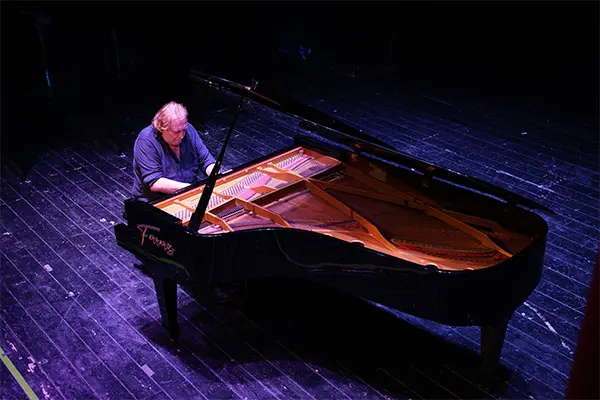
On the stage in Sassari, Paolo Restani covered some fundamental pages of the piano repertoire: from Debussy, with Élégie, Rêverie, La cathédrale engloutie and the Valse from the Préludes , to Chopin, with the Nocturnes op. 9 and the Polonaise op. 40 no. 2 and the Scherzo no. 2. In the second part, Rachmaninov and then Liszt, with Après une lecture du Dante: Fantasia quasi Sonata , completed a program in which the pianist gave space to that great Romantic tradition that is among the distinctive traits of his repertoire.
The Italian pianist knows that feeling well; his first recital came around the age of twelve, and shortly thereafter, while still a teenager, he made his debut at Santa Cecilia. " I remember being incredibly scared ," he says. He was fifteen or sixteen years old and found himself in front of an audience at the Auditorium on Via della Conciliazione, accustomed to listening to great performers. Then, once he began, he thought " only of the music ." The concert went extraordinarily well, and Francesco Siciliani, who had heard him in Naples, called him back first to the Teatro Argentina and the following year, for Liszt's Second Piano Concerto. " That's where it all started ."
More than forty years have passed since then, and his stages have included Carnegie Hall, La Scala, the Musikverein in Vienna, and the Teatro Colón in Buenos Aires, with collaborations that have included conductors such as Riccardo Muti and Vladimir Ashkenazy. For Restani, however, training is not limited to study and technique.
" The teacher is indispensable for providing confidence and tools, but the student must absorb the teaching and become himself ." In his journey, in fact, he reveals how crucial Vincenzo Vitale was, but also the interaction with other musicians and, above all, with orchestras and chamber music. " From other instruments and voices, a pianist learns phrasing and legato ." A constant learning, which leads to the need to communicate: " Music must reach the listener, because it is a story ."
This is the approach he brings to his masterclasses today; rather than transmitting formulas, Paolo Restani seeks dialogue with his students: " It's a dialectic: I don't impose anything and sometimes I learn from them too ." Because the stage, he explains, also teaches how to control the nervous system, to develop one's own ideas and to find a way to communicate them.
After Sassari, the series continues on October 31st at 6 pm at the Auditorium of the “Ennio Porrino” Conservatory in Cagliari, with the duo formed by Uto Ughi and Bruno Canino, who represent one of the most internationally prestigious Italian chamber music groups.
Tickets are available on Vivaticket, while the complete schedule of the festival can be found on the festival website.
www.itinerarimusicalidellidentita.it