


From cartoons to self-confidence: How English strengthens self-esteem and social skills
Per restare aggiornato entra nel nostro canale Whatsapp
For many Italian parents, the age between six and seven represents a significant transition. Children are no longer preschool-aged; they are developing deeper friendships, beginning to interact with their classmates, and becoming more aware of what they can—and can't—do.
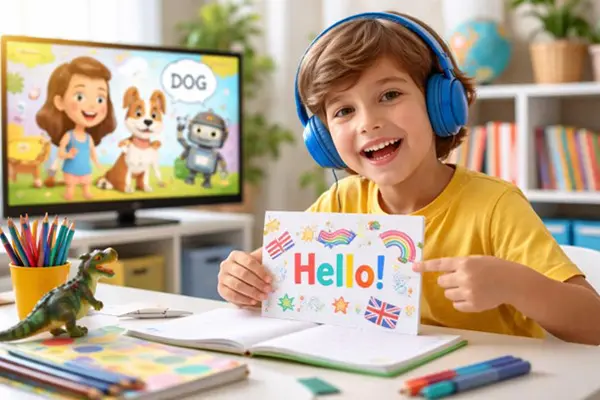
It's also the age when English becomes more present in their world: in cartoons, video games, YouTube videos, music, and at school.
What many families don't realize is that learning English at this specific stage of development doesn't just boost academic progress. Research suggests that language learning can significantly strengthen social skills, self-confidence, and emotional resilience.
Let's find out why.
Why the age between six and seven represents a critical social stage
Developmental psychology identifies this age group as part of what Erik Erikson called the "industriousness versus inferiority" stage. During this period, children begin to evaluate themselves based on their own competencies: they feel the need to perceive themselves as capable, successful, and appreciated.
If they encounter recurring difficulties—academic or social—doubt about their abilities may creep in. But when they experience a sense of mastery, their self-esteem grows.
English for six-year-olds can be a powerful source of positive reinforcement.
From passive vision to active understanding
Italian children are already exposed to English on a daily basis—often unconsciously.
Global media platforms offer a wide range of content:
- Cartoons and animated series
- Songs and nursery rhymes
- Video games
- Social media content
According to European Commission data, over 90% of children in the EU come into contact with English-language digital media before the age of ten. In Italy, specifically, consumption of English-language content among young children continues to grow year after year.
When a six-year-old child goes from simply hearing English in cartoons to understanding it, something important happens:
He transforms from a passive consumer to an active participant.
That moment of awareness—“I understand what they’re saying!”—builds profound self-confidence.
The virtuous circle of trust: small victories, big impact
Psychologists describe self-confidence as a virtuous circle:
- Try something new
- Experiencing a small success
- Feeling capable
- Try again with less fear
Learning English early creates repeated “small victories.”
When children:
- They recognize some words in a cartoon
- They answer a question in English
- They present themselves with confidence
- They understand the teacher's instructions
they experience their expertise in a tangible way.
Educational psychology research shows that perceived competence is one of the strongest predictors of self-esteem in elementary school children. Success in even one area can positively influence the child's overall self-perception.
Strengthening social skills through language
Language is, by its very nature, a social act. Learning English isn't just about memorizing vocabulary, but about practicing communication.
Between the ages of six and seven, children perfect essential skills such as:
- Respect conversation turns
- Active listening
- Express ideas clearly
- Managing frustration when you are not understood
Interactive English learning—especially when conversation-based—strengthens these skills.
Studies of bilingual children have also found a greater capacity for empathy. Because bilingual children regularly switch between linguistic systems, they develop a greater awareness that others may think or speak differently. This flexibility fosters empathy and social awareness.
In the classroom or in an online group, using English encourages children to:
- Take the floor
- Test yourself in conversation
- Practicing respectful dialogue
These are social skills that go far beyond learning a language.
Reduce future anxiety about English
In Italy, there is a significant social reality: many teenagers suffer from "performance anxiety" when they have to speak English.
According to OECD education data, Italian secondary school students often show less confidence in speaking English than their Northern European peers. This phenomenon is often linked to late exposure to the language, combined with an assessment system based solely on performance.
When English is first associated with grades, corrections, and exams, it can trigger a fear of making mistakes.
But when children start at six or seven in a playful and stimulating environment, English becomes second nature—no longer a source of awe.
When formal tests arrive later in the school year, the student will already be familiar with the language. And familiarity reduces anxiety, thus promoting better performance.
Building your identity in a digital world
Today's children grow up in a globally interconnected environment. Already at six or seven years old, they realize that the world extends far beyond Italy's borders.
Understanding English allows them to:
- Communicating with peers from other countries
- Access stories and characters from around the world
- Participate in international digital spaces
- Travel with greater independence
A sense of social belonging is profoundly important at this age. Feeling capable of interacting with the outside world strengthens the child's developing identity.
Instead of feeling excluded from English-language conversations or trends, bilingual children feel included.
In psychological terms, inclusion supports a sense of personal worth.
Encouraging healthy risk
Another often overlooked benefit of learning English early is resilience.
When children try to speak a new language, they are bound to make mistakes. In a positive learning environment, they learn that:
- Mistakes are normal
- Communication is more important than perfection.
- Trying again leads to improvement
This approach reflects what psychologist Carol Dweck calls the “ growth mindset” : the belief that abilities develop through effort.
At six or seven years old, this belief system is still being formed. Learning English can silently reinforce the idea that effort leads to progress: a lesson that applies to math, sports, music, and friendships.
Support the expression of emotions
Interestingly, some research suggests that bilingual children may find it easier to express certain emotions in one language than another.
For younger children, English can sometimes become a safe space for them to express themselves. Saying "I'm nervous" or "I'm excited" in English can make them feel less vulnerable than saying it in Italian.
Over time, this process expands emotional vocabulary and self-awareness, both key pillars of social development.
The role of a positive learning environment
Of course, the benefits of early learning depend on the teaching method.
Research consistently shows that, for six- and seven-year-old children, language acquisition is most effective when it is:
- Interactive
- Focused on conversation
- Encouraging, rather than correction-based
- Built around stories and games
Self-confidence grows when children feel comfortable speaking.
When lessons prioritize communication over perfection, children internalize a crucial message: their voice matters.
A foundation that goes far beyond the language
For Italian parents considering English lessons for their six- or seven-year-old children, it's helpful to look at the bigger picture.
Learning English early isn't just about preparing for future exams. It can also:
- Strengthening security in social relationships
- Foster empathy and flexibility
- Reduce long-term school anxiety
- Support the development of healthy self-esteem
- Building resilience through “healthy risk”
In a world where children are increasingly engaging with others—both in the classroom and online—feeling competent in a global language becomes more than just a simple academic skill.
It becomes an integral part of their identity.
From understanding a cartoon to being able to hold a simple conversation, every small achievement reinforces a fundamental message in them:
“I can do it.”
And at six or seven years old, this awareness has immense power.
