

Farewell to Nicola Pietrangeli, Italian tennis legend. Binaghi: "A monument, I've lost a friend."
He was 92 years old and the first Italian to win a Grand Slam (two Roland Garros titles in 1959 and 1960). The president of the Italian Tennis Federation (FITP) dedicated the last Davis Cup won by the Italians to him.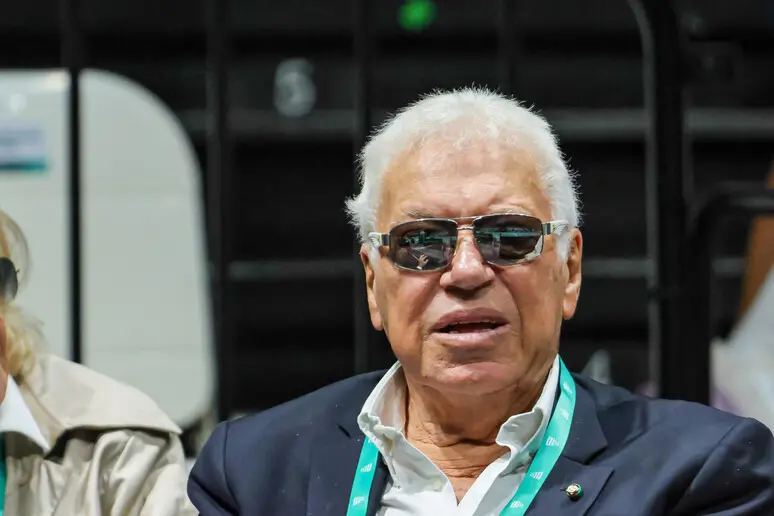
(Handle)
Per restare aggiornato entra nel nostro canale Whatsapp
Nicola Pietrangeli, the Italian tennis legend and the first to win a Grand Slam, has died at 92. He won the Roland Garros twice, in 1959 and 1960 (he also won the doubles title with Sirola in 1959) . On January 26, Sinner surpassed him by winning his third Grand Slam.
Pietrangeli was captain of the first Davis Cup won by Italy, in 1976 .
And it was to him, who was hospitalized, that Fitp president Angelo Binaghi dedicated the Davis Cup victory recently won by the Azzurri in Bologna , their third consecutive and fourth overall for our colors: "Nicola is the resurrection of tennis in Italy. We built this federation following him, his values, and his principles. We are all with him so that he can get back in great shape," Binaghi said after the triumph won by Cobolli and Berrettini.
The chapel of rest will be set up on December 3rd in the stadium dedicated to him within the Foro Italico, as he wished. The funeral will be held that same day at 3:00 PM in the Church of Santa Maria della Gran Madre di Dio in Ponte Milvio.
THE MEMORY OF BINAGHI
"Italian tennis loses its greatest symbol, and I lose a friend," said the FITP president today. "Nicola wasn't just a champion: he was the first to teach us what it meant to truly win, on and off the court. He was the starting point for everything our tennis has become. With him, we understood that we too could compete with the world, that dreaming big was no longer a gamble."
Again: "When we talk about Nicola, we immediately think of the records, the Davis Cups, the titles and triumphs that will forever remain in our history. But the truth is that Nicola was much more. It was a way of being. With his cutting wit, his free spirit, his inexhaustible desire to live and joke, he managed to make tennis something human, real, profoundly Italian ."

"Talking to him was always a pleasure and a surprise: you could leave a conversation laughing out loud or with a thought that stayed with you for days," Binaghi continues in his farewell letter. Then the anecdote: " In my office, there's a photo I hold dear: me as a child, a ball boy at a Davis Cup match in Cagliari, and in front of me, Nicola Pietrangeli. Every time I look at it, I feel like I'm going back to that day. And I realize that, ultimately, everything began there for me. That photo isn't just a memory: it's a symbol. The symbol of how a child can fall in love with a sport thanks to someone who embodies it so fully and naturally."
I owe him a lot, as a man and as president. Not just for what he did for the Federation and for all of us, but for how he did it: with style, with courage, with that irreverence that was the hallmark of true champions. In his own way, Nicola never changed: direct, sincere, incapable of being banal. Even when he provoked, he did so with an intelligence born of a profound love for our sport .
The conclusion: "Today we like to think that he has joined Lea in heaven, and that together they are already playing an extraordinary mixed doubles, having fun as only they knew how. Two icons of Italian tennis, inseparable even up there. But for those of us who remain, it is a very hard blow . We will miss his voice, we will miss his smile, his ability to always say what he thought, without fear and without filters. Today we say goodbye to a monument to our sport, but also to a true friend . Thank you, Nicola. For everything you have given us, and for everything you will continue to represent for Italian tennis."
THE CAREER
Born in Tunis to an Italian father and a mother of Russian origins, he came to Rome after his family was expelled from Tunisia. In Paris, he also lost to two finals, in 1961 and 1964.
In his career, Pietrangeli won 48 tournaments, including two Italian Internationals, and was number 3 in the world ranking for three years , which at the time was compiled by journalists before the advent of the ATP rankings.
In the Davis Cup he played 164 matches, winning 120 ("Sinner will never surpass this record," he said). And as a non-playing captain he led the Italy team of Panatta, Barazzutti, Bertolucci and Zugarelli to the historic triumph of 1976 , with the final won in Pinochet's Chile.
(Unioneonline)
