

EU-Mercosur trade agreement for world's largest free trade area approved
The agreement with Argentina, Brazil, Paraguay, and Uruguay eliminates 91% of tariffs, with savings for European exporters estimated at 4 billion euros.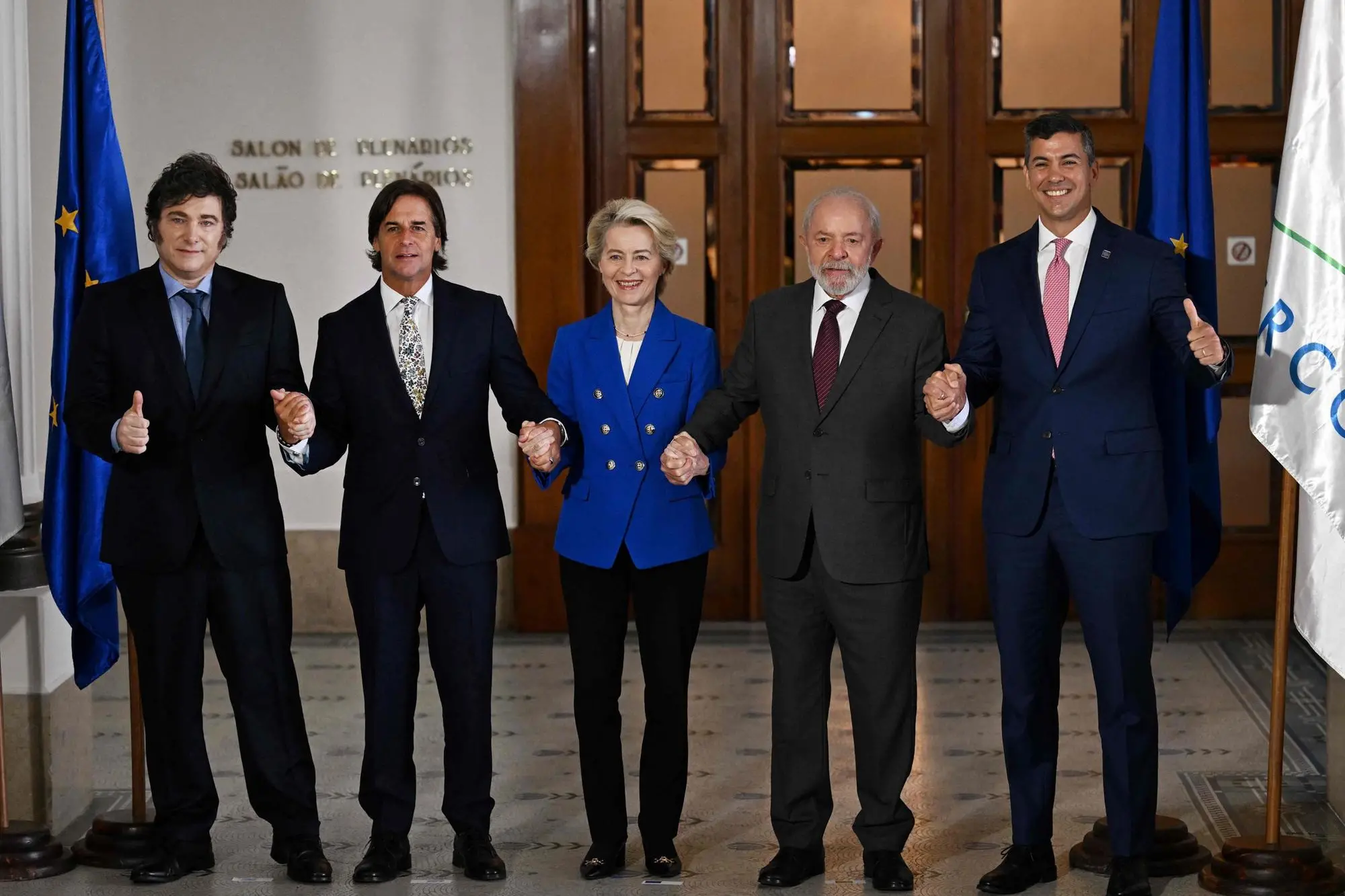
Per restare aggiornato entra nel nostro canale Whatsapp
EU countries (Italy among those in favor, while France, Poland, Austria, Hungary, and Ireland voted against) approved the trade agreement with the Mercosur member nations of Argentina, Brazil, Paraguay, and Uruguay. A market of 700 million people for the world's largest free trade area.
The two parties will now be able to formally sign the agreements, and European Commission President Ursula von der Leyen will fly to Paraguay in the coming days for ratification, along with European Council President Antonio Costa. Furthermore, before the agreements are formally concluded, the European Parliament will be asked to give its approval.
The EU is Mercosur's second-largest trading partner in terms of goods, accounting for almost 17% of Mercosur's total trade in 2024. In the same year, EU trade with Mercosur amounted to over €111 billion: €55.2 billion in exports and €56 billion in imports, with trade in goods between the two blocs increasing by over 36% compared to 2014. In 2023, trade in services between the EU and Mercosur amounted to over €42 billion. To date, 60,000 European companies, half of which are small and medium-sized enterprises, export to the Mercosur area.
The trade agreement eliminates 91% of customs duties—currently 35% on auto parts, 20% on machinery, 18% on chemicals, and 18% on pharmaceuticals—leading to an estimated annual saving of €4 billion for European exporters. Customs procedures will also be simplified to facilitate exports, and EU companies will be able to participate in public procurement tenders on equal terms with Mercosur companies.
Many tariffs on agricultural products are also eliminated—currently 28% on dairy products, 20% on chocolate, 35% on spirits, and 25% on wines—and 344 EU protected geographical indications are recognized, the highest number in any free trade agreement concluded by the Commission. Among these, 58 are Italian protected geographical indications: from Balsamic Vinegar of Modena to Gorgonzola, from Mozzarella di Bufala Campana to Parmigiano Reggiano, from Pecorino Romano to San Marzano tomatoes, from Prosciutto di Parma to San Daniele, from Grappa to over 30 wines: from Barolo to Chianti, from Lambrusco to Prosecco. The agreement also provides for limited access to the EU market for agri-food products considered sensitive for the Old Continent, such as beef, poultry, and sugar. Furthermore, "any product entering the EU market must comply with the EU's rigorous food safety standards," and the "precautionary principle" is reaffirmed, according to which both parties are free to take measures to protect human, animal, and plant health, even in situations where scientific information is inconclusive.
ITALY – In 2024, Italy's agri-food exports to Mercosur amounted to €489 million, with tariffs ranging from 27% to 55%. With the agreement, these tariffs will be reduced to 0%. Furthermore, Italy's total trade with South American countries amounted to €16.4 billion (the figures reported refer to trade in goods in 2024 and services in 2023).
(Unioneonline)