


3 minutes with a teacher in Cagliari: math isn't all bad.
The statistics professor who's a hit on social media is a guest of the Giuseppe Siotto Research Foundation.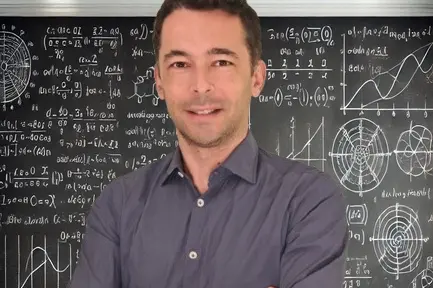
Per restare aggiornato entra nel nostro canale Whatsapp
Vincenzo Mauro, the statistics professor who's a hit on social media with his 3minuticolprof channel, is coming to Cagliari, hosted by the Giuseppe Siotto Research Foundation for two unmissable events on January 22nd and 23rd.
Professor, mathematics is ugly and mean, yet you have hundreds of thousands of followers on social media.
It's always struck me that we try to hide our ignorance on certain topics while flaunting it when it comes to science, to the point that not knowing it almost becomes a source of pride. It's a short circuit that I try to address in my show "Random Stories." Mathematics, however, pervades every aspect of everyday life, so not knowing it puts you a step behind.
Is there any responsibility on the part of the school?
For me, it's completely true, because it's the school that chooses the teaching methodology. This is also why my pages were created: I'm a statistics professor, one of the most challenging areas of mathematics, if you will. I decided to try teaching it by challenging conventions. That's where my project was born, because my lessons are like theatrical pieces where I wander around the classrooms, use examples no one would use, and show it from unexpected angles. And I try to speak a language different from the academic standard.
Hasn't even the power of Sheldon Cooper with The Big Bang Theory managed to shake up the idea of STEM subjects as something boring?
That series, while wonderful in some ways, offers a somewhat stereotypical idea of mathematics: the protagonists are brilliant nerds who are quite unfamiliar with real life, except for Penny, the only character connected to real life but who knows nothing about science. But I love it, I even used it as the theme song for my videos.
For Sheldon Cooper, 73 is the Chuck Norris of numbers. What's his favorite number?
I have a soft spot for the square root of two, for its truly incredible story linked to Hippasus of Metapontum, who put the Pythagorean school into crisis. But I also have a soft spot for the number 17, which is linked to Gauss and the heptadecagon, a 17-sided figure he discovered could be constructed with a straightedge and compass, and it was one of the most incredible yet seemingly simple discoveries in the history of mathematics. He wanted it on his tombstone, but the stonemason refused because it had so many sides it would have looked like a circle. And in fact, I played soccer for many years and always wore the number 17 shirt. And then there's pi, but the ranking would be 17, the square root of two, and finally pi.
He has often taken a stand against gambling, even legalized gambling.
I'm convinced, to use a somewhat clichéd phrase, that with great power comes great responsibility. What I'm trying to do is dismantle the myth of method, the idea that thanks to your mathematical knowledge you can beat the house, cheat the system, and get rich so quickly. The state doesn't help you much, perhaps because there's a significant conflict of interest, given that it rakes in €12-13 billion a year from legalized gambling.
Last night he presented his book “Numbers (almost) never deceive”, published by Longanesi.
I wanted to write a book that communicated something, and I wanted to write it my way, with my method. I think the book came out quite unique, because on the one hand, it's rigorous, it talks about mathematics, but with a tone of voice that I think is rare, especially from a university professor. So, the reader encounters swear words, irreverence... it's a completely unusual way to talk about it. I really like it, and I think it's had a certain success for such a niche book. I'm very happy with how it's going, and above all, the people who meet me have grasped this desire to talk about concepts usually considered boring or even useless, very abstract, in a way that makes people say, 'Oh, but that's how it was,' 'So I also find mathematics when trying to meet a girl or when I think about aliens.' There you have it, it's the mathematics of the common man.
See you tonight at 9 pm at the Siotto Foundation with “ Storie a caso ”, a show that tells the surprising – and surprisingly ordinary – lives of scientists who have changed the world.
