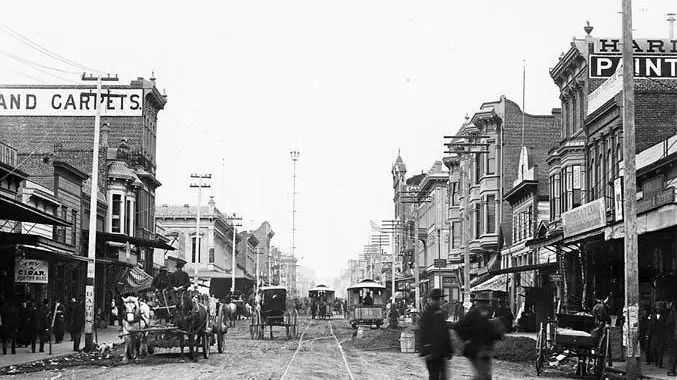


It was not a more civilized Eastern state, but the rugged frontier, that first granted American women the right to vote. It was December 10, 1869, and in Cheyenne, Wyoming—a territory of vast prairies and mining, established the year before on the edge of the transcontinental railroad—Governor John Allen Campbell signed a mere bill: "Every woman twenty-one years of age or older residing in the territory has the right to vote and to hold public office." It was a historic moment, but none of those men of high caliber could grasp its significance. Yet it was the first time that an American government, even one not yet a state, had granted women full electoral rights.
No celebration, no idealism: in the great West, even this record in US history was still a matter of frontier and reconstruction. A political calculation, in short, that nevertheless paved the way.
To understand why this happened in Wyoming, we must remember that it was a young area, populated primarily by miners, construction workers, and cowboys. Women were a clear minority, and for the cities to grow, new residents, families, schools, and services were undoubtedly needed. Therefore, the area needed to be made more attractive to women, whether married or single.
It was also a peculiar year. The Civil War had been over for four years, and in those months the Fifteenth Amendment of the United States was being debated, which would extend (at least on paper) suffrage to black men but not to women. The suffrage movement, which had hoped to enter the new era of rights, was split: on one side, the National Woman Suffrage Association (based in New York) of Susan B. Anthony and Elizabeth Cady Stanton, on the other, the American Woman Suffrage Association (based in Boston), more inclined to support the Fifteenth Amendment.
In this great debate, Wyoming took action. Having granted women the right to vote in 1870, Louisa Ann Swain of Laramie was among the first women to vote in a general election, while in South Pass City, Esther Hobart Morris was appointed justice of the peace, the first woman to hold such a judicial office. During that same period, women in the territory were also serving on juries, an innovation that caused a stir, and often ridicule, in the New York and Boston newspapers.