

Guspini, a rare Sardinian goshawk rescued along the provincial road
He was soaked and stunned on the asphalt. A Forestas employee found him and handed him over to the Monastir wildlife center.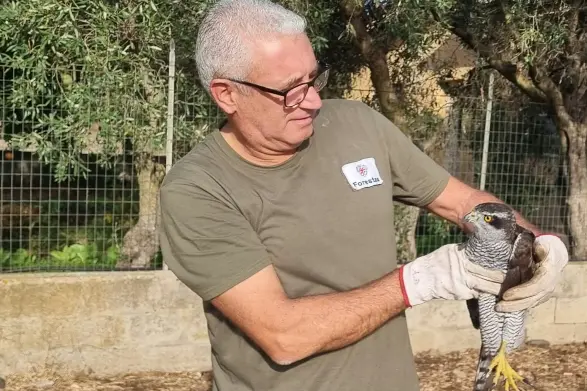
Per restare aggiornato entra nel nostro canale Whatsapp
A providential intervention in Sessini, a stone's throw from Gentilis, by Alessio Pilloni, a Forestas employee. The protagonist is a female of the extremely rare Sardinian goshawk, an endemic subspecies found only in the forests of Sardinia and Corsica, considered one of the most precious and difficult-to-spot birds of prey in the Mediterranean. It is now at the Wildlife Recovery Center in Monastir. It could have ended up under the wheels of a car. Instead, it was saved. It was stunned, motionless, soaking wet in the middle of the roadway of the SP 65, in Sessini, a stone's throw from the Gentilis park, under the first autumn rains that have been battering the area in recent days.
Alessio Pilloni, an employee of Forestas, who works in that very area every day, found it. "I was on my way to work when I saw the small bird of prey lying motionless on the asphalt," he said. "I immediately stopped and ran over to it: it appeared unharmed, but it appeared stunned, unable to fly again. The predator, left soaked on the ground by the first autumn rains, was unable to hunt, and hunger quickly weakened it."
A near-miss rescue. The SP 65 is a narrow road, busy at that hour with farm vehicles, tourists, and trucks. A moment longer, and he would have been hit. "Fortunately, he wasn't hit by any vehicle," Pilloni recounts. "I picked him up gently and carried him to a nearby farm in Serpi. There, I fed the animal, a female, because she was stunned. During initial treatment, she showed signs of wing problems. A cursory examination showed no signs of gunshot wounds; the injuries were likely caused by contact with tree branches or a power line."
A detail that immediately rules out human intervention and suggests a flight accident, not uncommon for a hunter who makes a living darting at full speed through the thick forest. After initial assistance, the female responded immediately. Following treatment, she responded positively, regaining strength. Her eyes, but especially her beak and talons, became menacing to anyone who approached. The most beautiful sign: the predator was returning to its former self, wild, untamed, ready to defend itself.
"He almost didn't want to leave his temporary home," Pilloni smiles. Then the transfer. "The treatment continued late in the morning, after prior notification, at the Wildlife Recovery Center in Monastir, managed by Forestas, for the necessary care," Pilloni explains. "The bird of prey certainly needs to be released back into the wild. Keeping him confined in an environment that isn't his own risks transforming him into a species unsuited to nature. He belongs in the woods, not in a cage."
Veterinarians in Monastir will now monitor him to determine the extent of the injury to his wing. The goal is clear: to release him back into the wild as quickly as possible, in the same area where he was found, among the holm oaks of Gentilis. The Sardinian goshawk is lightning fast. One of the fastest birds in nature, its extraordinary agility allows it to swoop down on its prey without its knowledge. A silent and lethal hunter, it is a symbol of the surrounding woodlands. It is no coincidence that sparrowhawk and goshawk pairs find the ideal home in Gentilis for breeding and hunting: dense, pristine, peaceful holm oak forests, far from human disturbance. A perfect habitat that must be protected. A unique diurnal bird of prey, it lives only in mature forests, hunting primarily small birds, and to do so, it has the perfect weapon: short, rounded wings, a long tail, and incredible agility that allows it to dart between branches and trunks with maneuvers impossible for any other bird of prey.
Mauro Serra