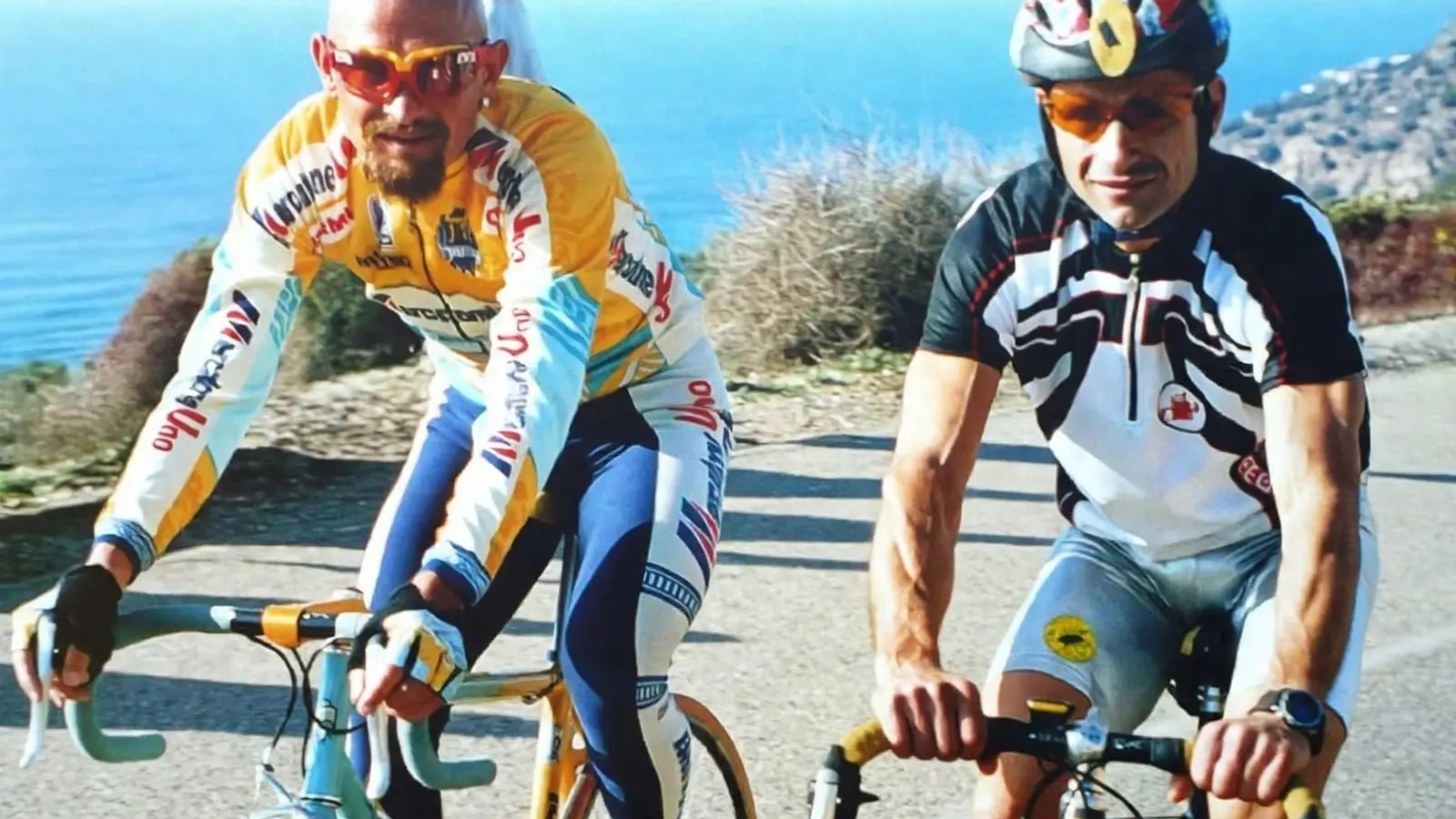


Almost twenty-seven years have passed, but some days never get old. For Vittorio Serra , a longtime Sardinian cyclist and artisan frame builder, that day was in early 2000, on the coastal road that descends from the southwest of the island towards Pula . Winter sun, a mistral wind at his back, the sea below. And next to him, astride a celeste Bianchi wearing the yellow jersey of Mercatone Uno, was Marco Pantani . "It's a Giro I've relived a thousand times," Serra says today. "Just me and him. Me and the Pirate." Pantani was thirty and two years earlier had won the Giro and the Tour. Serra was forty-two and was enjoying his best season: regional elite cross-country champion, three months earlier he had invented and won the first edition of the Serpilonga, and that same year he would conquer the Iron Bike.
Even before setting off, Pantani's attention turns to Serra's bike, leaning against a wall. It's the Monolite, a carbon frame that Serra had built himself, using prototype molds, between Villacidro and the basement of his house in Sinnai. It weighed seven kilos, at a time when such a weight was almost science fiction. "He lifted it with two fingers, like a feather," Serra recalls. "He put it down, lifted it again, his eyes widened, and said to me, 'Vittorio, what the hell is this? It weighs nothing.' I explained to him that it was carbon, rubber, and little else. When I made it, people around didn't even know where to start."
"He ran his hand over the frame, the undercarriage, the fork, like you'd caress a horse before a race," Serra continues. "Then he tried it for a hundred meters, got off, and looked at me seriously. He told me it wasn't a bike, it was an animal: when you push, it responds immediately, it doesn't waste anything, it seems to climb on its own. And then, in that Romagna voice of his: 'Your bike is beautiful, I want one too!' I replied, laughing, 'I'll make it for you, Pirate. But you'll have to come and get it in Sinnai.' "