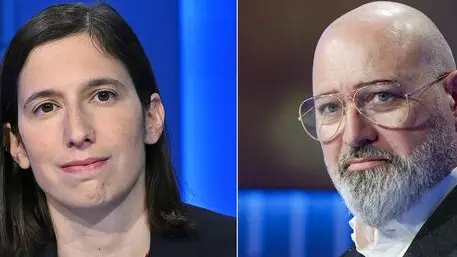


At the national level, considering the results of the votes conducted in various circles, Stefano Bonaccini would seem to be able to consider himself the next secretary of the Democratic Party in its entirety. Immediately behind him, Elly Schlein follows with a rather high percentage of sympathizers ready to share with the very young contender a left-wing idea that looks back to its origins, to its most positively representative roots, useful for defining the future profile of identity and values of a party which, probably in deeds more than in its intentions, could distinguish itself once again in ideological diversity, and then, perhaps, necessarily fragment itself into two distinct units: one more directed towards the progressive centre, and one more directed towards the best founding values of the left, such as those of the party when it was characterized by being strongly representative of the working people and the less well-off classes.
And probably, in this sense and juncture, Elly Schlein's idea of changing the nomenclature of the political creature that will emerge from the present congressional period was not all that farfetched, if only we recall the profound words of Martinazzoli when, years ago, on the occasion of the opening speech of the political secretary to the work of the constituent programmatic assembly of the DC held in Rome in July of the year 1993, in view of the future development of his own Party, in posing precisely the question of the change of denomination, he had observed not wanting to "follow the futility of a fashion (or) cut cleanly the continuity of a tradition", but rather wanting to advocate the image of "renewing without denying". And if it is true, as it would seem to be true, that the Democratic Party was born precisely, among other things, to conquer a slice of the Catholic electorate motivated by sharing the ethical and also cultural pluralism typical of globalization, without however forgetting its own system of values , then it would seem that the political vision shared and carried forward by the gritty Elly constitutes the winning interpretation for a party aggregation which as a whole, to date, does not seem to be able to find unity in diversity.
In other words: regardless of whoever prevails in the electoral competition for the secretariat of the Democratic Party, he certainly cannot overlook the sentiment of that large percentage of voters and members who would like a strong identity-based party formation. Where the ideological setting of this significant percentage of members and sympathizers were to be neglected in some way by the new secretary, the path of split could prove inevitable, with all consequences in terms of the electoral weight of a Party that has always been characterized by placing itself at the top of the preferences of most Italians. Let's be clear, however, on some qualifying points: the country currently needs important structural interventions, probably epochal, which are useful for facing and overcoming the challenges that the current times, between the Pandemic and war, are imposing on us; the answer clearly cannot come from right-wing populism, nor from the experience of the so-called social democratic left which, indeed, retains a purely historical value now exhausted in its essential cycles.