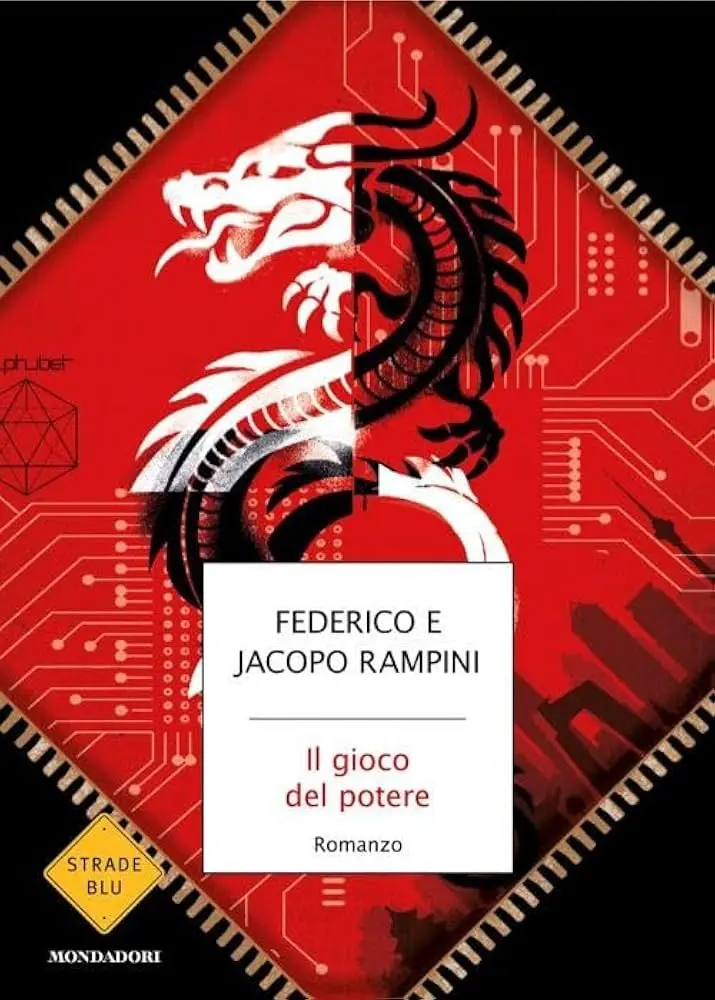












In 2027, the world is on the brink of war: China is besieging Taiwan and the United States is preparing a response. In the midst of this titanic clash, an Italian company becomes a highly sought-after prey. It is NaviTech, a leader in the production of advanced microchips, and it possesses industrial secrets that could change the fate of the world. The two major powers in the world want to control it, but the war between China and the United States is not the only war the company must face. Ottavio De Luca, the visionary founder, has never designated an heir. A violent struggle for succession is therefore brewing. The favorite seems to be the eldest daughter, Caterina, who has supported Ottavio throughout his life, with excellent results. Her nephew, Stefano, the current CEO, is, however, willing to do anything to maintain power. In this duel, no one seems to give credence to the youngest son of the founder of NaviTech, Gregorio, who has always been considered the black sheep and who, to escape his father's shadow, moved to New York and pursued his dream of becoming a photographer. His career, however, never took off and, as he approached forty, the weight of failure ignited in him a desire for redemption. A desire that soon became a real craving.
With The Game of Power (Mondadori, 2025, pp. 372, also e-book) Federico and Jacopo Rampini construct a fast-paced thriller, centered on a ruthless game for absolute hegemony, in which alliances break, principles bend, and loyalty is sold to the highest bidder. A thriller that offers a non-trivial reflection on how technological innovation can determine the fate of the planet, but which is also the story of a father and son, divided by misunderstandings and silences, who in the chaos of events will find a way to reconnect.
We then asked Jacopo Rampini to tell us how the idea for a novel like The Game of Power was born:
“It was born from the desire to return to work with my father, after a theatrical experience together, and from my dream of transforming his geopolitical essays into a fictional story. I always thought they contained all the elements to become narrative. I was inspired by the idea of an Italian Succession: in our case too there is a family business and a father-son conflict, but with the addition of the geopolitical dimension, which is my father's field. The result is a story that intertwines drama, technology, identity and power, seeking a language capable of making reality dialogue with imagination. For me, who comes from the world of cinema and television, this novel was also a first step towards audiovisual adaptation, with strong characters, family dynamics and plot twists anchored to major global themes”.