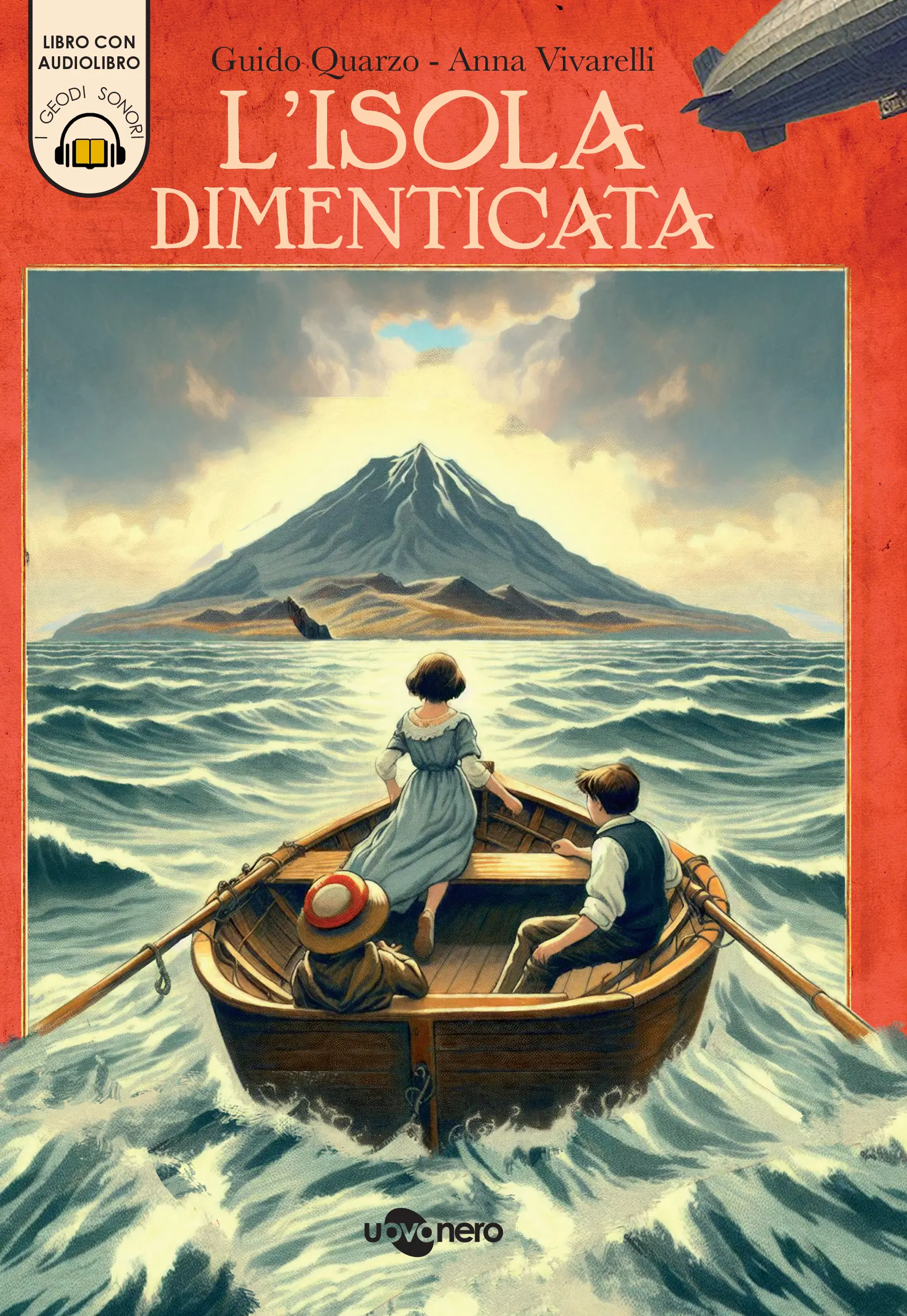












The year 1914: winds of war are blowing in Europe. A storm destroys the ship Zeus bound for Brazil. A small dinghy with two boys and a girl on board resists the fury of the waves and lands on the beach of a remote island. The crew is made up of Isabella, smart and enterprising, her older brother Giacomo, shy and disliked due to his numerous tics, and the young Franco-Genoese cabin boy Lucas, accustomed since childhood to survive even in the harshest conditions. They are the three protagonists of "The Forgotten Island" (uovonero, 2024, pp. 176), a novel for girls and boys co-written by Anna Vivarelli and Guido Quarzo and also available, thanks to the collaboration with Emons, in a narrated audiobook by Stefano Guerrieri and downloadable via a QRcode inserted in the paper book.
Having landed on the island, home to a prison until recently, the three castaways discover that it is not uninhabited at all, but populated by a group of strange characters, five men and a woman, a small colony led by a self-styled Governor. Each of them created a second life and a new identity. The kids will gradually learn the reasons that keep them hidden in that place far from everything: a small paradise surrounded by the sea where they can be free or prisoners, depending on their point of view.
Metaphor of adolescence and story about the desire to build or re-build one's destiny, "The Forgotten Island" is a novel with many references to the classics of literature and theatre.
We then ask Anna Vivarelli what were the sources of inspiration for the book:
«Certainly "The Forgotten Island" owes a lot to our readings, but, as always happens to us, we discover these literary sources a posteriori, when the story is finished and we reflect on our work. The first title that comes to mind is Robinson Crusoe by Defoe, but only for the literary topos of the desert island. Much more present is Georges Simenon's The Hotel of the Return to Nature, which struck us above all because it was based on a series of mysterious crimes that actually happened on the island of Floreana. in 1934. But in the spoiled and inept boys who become adults thanks to a shipwreck there is certainly an echo of Kipling's Captains Courageous and Verne's The Mysterious Island In an attempt to govern themselves on a distant island, the immediate reference It's like Golding's Lord of the Flies. The play of deception and roles between characters who seem to recite a script written by themselves harks back to Pirandello's theatre certainly born from our experience as readers, but no more and no different from our other novels".