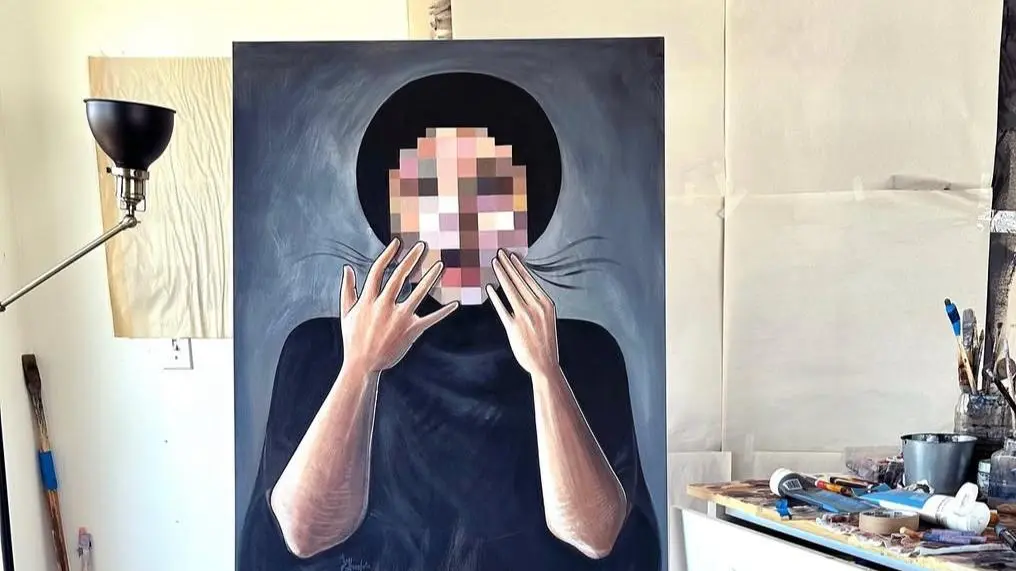


It is the disturbing image of an Afghan woman with a “pixelated” and invisible face that has been chosen to identify the 12th Life After Oil International Film Festival, which will be held from 17 to 21 June in Villanovaforru, dedicated, as always, to the environment and human rights, but with particular attention to the rights of women and children:
"It is an iconic image", said Massimiliano Mazzotta, creator and director of the Festival, "taken from the original painting by Shamsia Hassani, the first courageous Afghan female graffiti artist, who unfortunately well represents the condition of Afghan women under the Taliban dictatorship: as she denounces, with the strength of her art, with which she tries to give voice to Afghan women, £the new Taliban laws particularly affect Afghan women and girls, prohibiting women from speaking or showing their faces outside their homes. They are literally removing women from society”. An emblematic condition, but almost absent in the media after the first wave of indignation, and which can be taken as a symbol of the rights denied to many women in the world, of the violence, abuse and inequality to which they are subjected. We have dedicated this edition in particular to women and for different and complementary reasons to children, often victims of all forms of violence, sacrificial victims in war scenarios, to their denied future, often due to living conditions and latitude».
There are 916 cinematographic works arriving from all continents, a sign of the success and growing prestige of the Festival worldwide, 48 of which are in competition, chosen by the Selection Committee: «The works arriving, again this year», Mazzotta underlines, «deal with the specific themes of the Festival, rights and environment, with little positive news but not completely absent: ours is one of the few Festivals in Italy, which deal with these themes», powerfully returned to attention in the wake of the message left to humanity by Pope Francis. «Villanovaforru, home of the LAO for 5 years, with its squares, its archaeological sites and its history has become a true international laboratory of comparison, discussion and elaboration through cinematographic art, an emblematic place of resistance to build a better world for all».