




















We live in an era of cancel culture, and we delight in erasing everything we don't like about history and in history. Fortunately, some events and personalities from the past—but for how long?!—resist the frenzy of wiping out our roots and traditions. This is the case of Francis of Assisi, whose figure remains immensely popular, making him a universally beloved role model. A symbol of meekness, humility, and peace, Francis thus finds himself not only a major figure in the history of Christianity, but also a source of inspiration for our contemporaries. Indeed, his example is considered relevant and "new" even nearly eight hundred years after Francis's death in October 1226. We cannot help but wonder what the secret of such strength lies. The saint's early biographers speak at length of the innovation Francis represented, of the power of his words, but above all, of his example to amaze, engage, and inspire. They also speak of his being a normal man despite the "enormity" of his choices inspired by the evangelical model: "If you want to be perfect, go, sell what you possess and give to the poor, and you will have treasure in heaven; then come, follow me," says Jesus in the Gospel of Matthew, and so did the future saint.
Today, however, we tend to emphasize and even overemphasize Francis's real or supposedly modern aspects. We consider his love of nature revolutionary, making him an ecologist ahead of his time. We fondly recall his close bond with Clare during an era, the Middle Ages, when religious men were more likely to fear than appreciate women. We enjoy rereading the story of Francis in the light of multiculturalism and inclusiveness. In 1219, at the height of the Crusades, he traveled to Egypt and the Holy Land to speak to Christians and Muslims about a different way of living together. He was received by the Sultan of Egypt and spoke with him about peace.
These are all fascinating and enjoyable reinterpretations of the figure of the saint from Assisi. They are also, let's face it, convenient readings, which allow us to grasp the character's identity that we feel most relevant to our own times. It is the Francis we like to evoke.
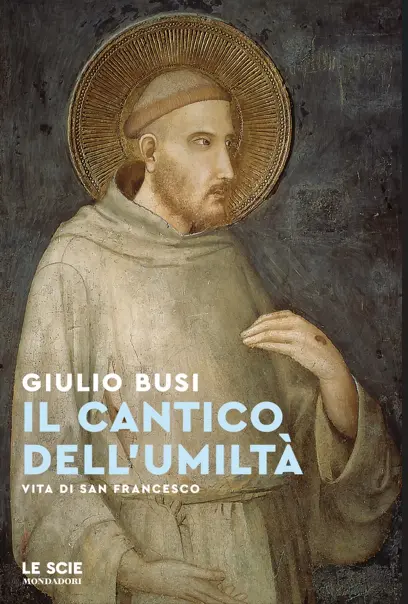
In retracing the life of Francis in his Il cantico dell'umiltà (Mondadori, 2025, €20.00, 156 pages. Also available as an ebook), Giulio Busi takes a different path than the most popular. Busi sets out in the saint's footsteps, or rather, he explores with him the brief but intense journey Francis traveled from the moment he decided to abandon his worldly life (around 1204-05) until his death. He does so by sifting through contemporary chronicles, immersing himself in the boundless sea of hagiography and sources, and then paints a unique Francis, vigorous, at times gentle, more often provocative and uncompromising. When forced, Francis knows how to obey and accept authority. But it is a choice that costs him, and from which, each time, he sets out again in pursuit of the truth. An uncomfortable truth, which makes the search restless and at times painful, especially since Francis did not shy away from the spirit of his time. He did not choose a life of prayer in a cloister, nor the isolation of a hermit. He lived as a man among other men, constantly seeking his own path, knowing he was breaking down barriers and overturning systems of thought. Francis "inhabited" an era of great economic expansion, in which the value of a human being was also measured by his wealth. The poor were often despised and marginalized. Francis, however, loved them and considered it the duty of every human being to help those in need. He showed the same concern for the sick or infirm, going against the dominant thinking of his time, a thinking that considered illness a divine punishment for sins committed. In his early days, the right-thinking ridiculed him, considering him a madman. Meanwhile, however, his charisma attracted more and more followers. Young people from across Christian Europe left everything behind: wealth, home, and family, and became Franciscans, or rather, "lesser brothers," brothers who shared the plight of the least fortunate in society and the Church. It was a true earthquake that shook Christianity to its foundations, but also restored its strength. Christ became a model finally attainable, and thus a horizon of infinite possibilities opened up before humanity.
Within a few years, the movement's success was overwhelming. And the founder's doubts became increasingly agonizing. The Church needed a strong, efficient, and solid Franciscan Order. But would Francis be able to defend poverty and humility, to maintain the simplicity of his origins? This was the great dilemma that gripped the saint as his strength failed and he felt he had lost hope and faith. Or was his faith wavering, dimming like a candle when a door suddenly opened and the wind came in? At the end of his life, so brief and intense, Francis was ill and disillusioned. He seemed defeated, but in his darkest hour he dictated the Canticle of Brother Sun, the Canticle of the Creatures, a splendid, joyous beginning to Italian literature. Thanksgiving to God was the opening, while the conclusion was a hymn to the humility that must guide everything and to which everything must conform. With that repeated and insistent "Praise be to you, my Lord," Francis pays homage to the Creator, but also to all creation, including death, which he calls his sister, for without it, there would be no access to eternal life, and without it, there would be no human existence. Having composed the Canticle, having rediscovered the path that seemed lost, but was only hidden by the fog of doubt and pride, Francis has now rediscovered the threads of his own life. He has discovered within himself what he has always known: there is only one source, creation has a single purpose. And now his Canticle is free to travel the vast world. May pain go away with him, and with him may praise spread among all who have the desire and, above all, the humility to hear it. Francis can then face his final time with serenity, without fear. He knows that his sovereign, who possesses all, defends and protects him. He has awaited him throughout his mortal life: eternal, majestic, patient, ready to meet him.