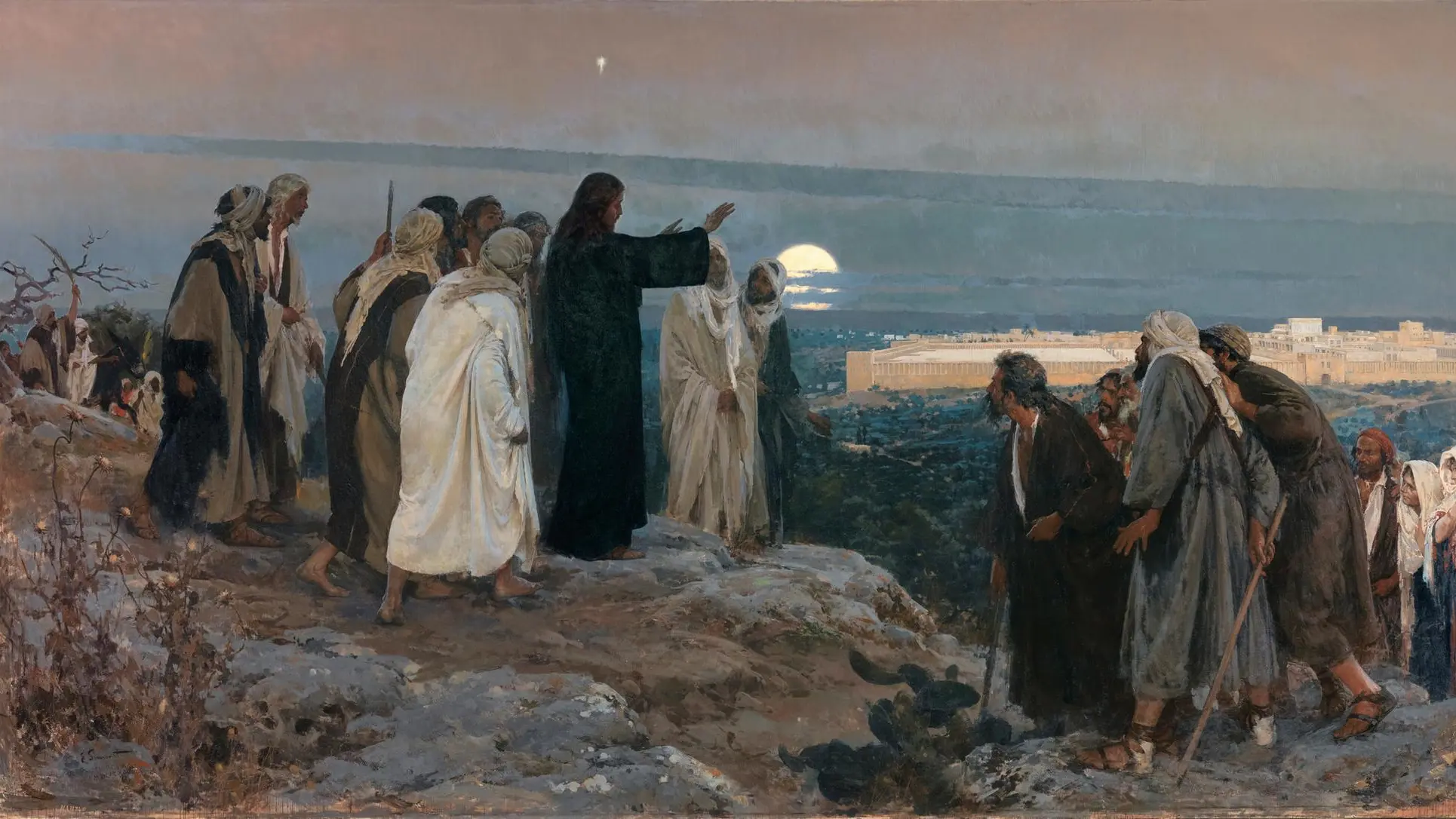


How do we imagine Jesus? Too often young, blond, charismatic like a Hollywood star. We then imagine him perpetually engaged in long journeys, besieged by huge crowds and taken up with his mission. Above all, iconography and also Catholic theology give us back the image of a Jesus who is more divine than human, with the thought perennially turned to his destiny as Savior. A Jesus essentially passing through the Earth, waiting to take back his rightful place at the right hand of the Father, in the highest heavens, to use a doctrinal formula.
What we have said is the result of a narrative that has settled over the centuries and has built an imaginary that is not entirely false and fallacious, but certainly distorted and illusory. More simply: reductive and guilty of distancing the man Jesus, his earthly life from us. This imaginary leads us to forget that in the Christian faith it is God who becomes human in order to be able to move freely and unconditionally among human beings like him. In short, in Christianity there cannot be the divinity of Christ without his humanity, without his corporeality and finiteness.
This seems to us to be the decisive message proposed in these Easter days by a volume that has just arrived in bookstores and with a title that is certainly evocative for anyone of us who has ever set foot in a church and listened to the reading of a passage from the Gospel: "At that time" (Solferino, 2023, euro 17, pp. 256. Also Ebook). The subtitles on the cover warn that we are dealing with a daily history of the origins of Christianity and a volume that recounts the events from Jesus to Saint Paul through the numbers - and not those of the verses, mind you - of the New Testament. It could not have been otherwise since the author, Roberto Volpi, is a long-time statistician, used to thinking about figures, quantities, percentages and statistics. However, Volpi did not want to make a volume of curiosities or amaze readers with who knows what cabalistic revelations. As a good statistician he relied on numbers to have a solid and habitual basis for him with which to start his reasoning and then deepen, thus managing to leap back in time and find himself in the Galilee of almost two thousand years.