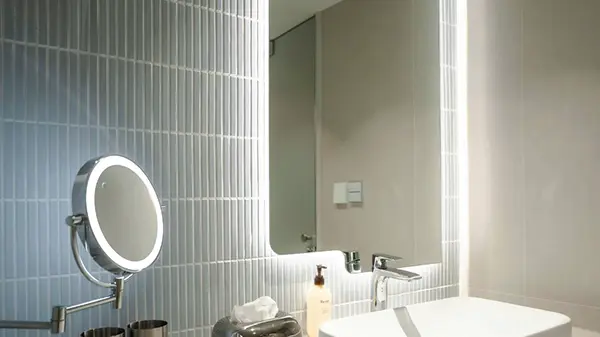


How much time do we spend in front of the mirror in the bathroom?
It happens every day, when we wash, put on makeup, or shave, and the light must be perfect. Uneven lighting, shadows, and distorted colors don't guarantee the same result.
There are mistakes to avoid and practical solutions to adopt to ensure your bathroom is impeccable. Adjustable lights allow you to adapt the lighting to your different daily needs, making every gesture more decisive and comfortable. The positioning of the light sources also plays a fundamental role.
Let's find out together how and which ones to choose.
Why mirror lighting is so important
Mirror lighting is often misinterpreted as a purely aesthetic issue. The truth is, choosing good lighting is essential for personal grooming. Makeup and shaving require well-designed lighting to provide a true-to-life view of the face, without shadows, ensuring a uniform result.
Poor color perception, on the other hand, can completely alter skin tones, which is why it is necessary to distinguish between beautiful and functional light.
At Rubinetteriashop you'll find the solution that combines practicality and aesthetics.
Mistakes to Avoid with Bathroom Mirrors
Mirrors necessarily require lighting, but this can vary depending on the space. In a small, dimly lit bathroom, a mirror with overhead lighting may be the wrong choice.
Light from above casts shadows on the face and distorts color perception. Shadows appear under the eyes and nose. The chin also takes on a different shape and reflects an unrealistic image.
Another important mistake to avoid is uneven lighting placement. Lights too far from the mirror, such as side sconces or double symmetrical shapes, can distort the light and reflect an image that doesn't match the truth.
Errors continue when we choose lighting that's too warm or too cold: cold lighting creates a sterile appearance, commonly known as the hospital effect. Light that's too warm, on the other hand, produces distorted colors. Uneven lighting also creates harsh shadows. This effect, typically the result of spotlights, creates spots of light.