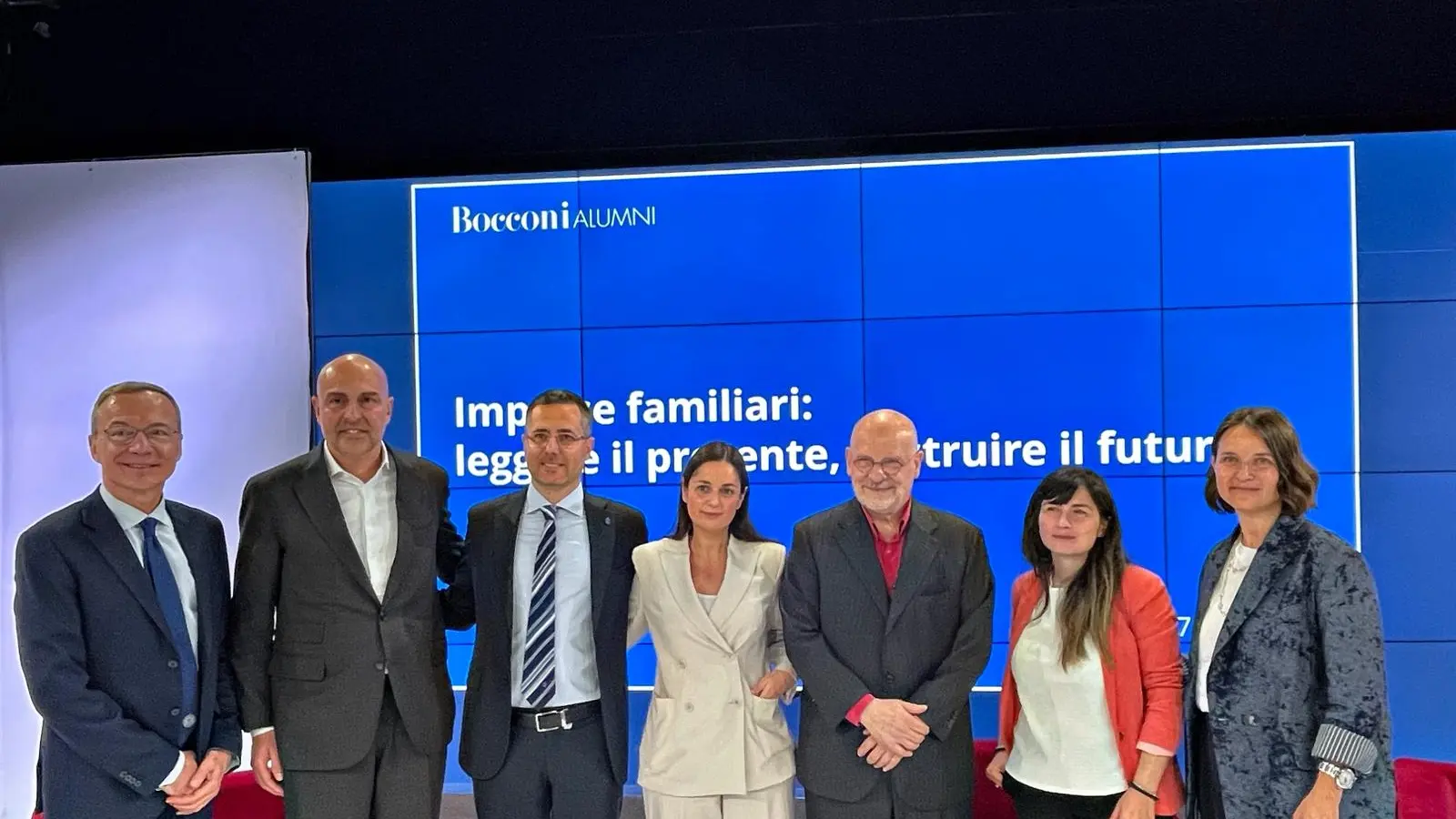


Across generations and through storms. If there's one business that, more than others, has been able to withstand the impact of crises and survive, even pursuing unexpected growth, over the last twenty years, it's the family business. This is what emerges from data collected by the AUB Observatory (Aidaf, Unicredit, Bocconi), presented by Carlo Salvato, Deputy Pro-Rector of Bocconi University, in the "Giorgio Pisano" multimedia room of the Unione Sarda, during an event organized by the Bocconi Alumni community in Cagliari, led by Chapter Leader Alberto Piras . "We observed, using twenty years of data," explains Salvato, "the financial crises of 2008-2009 and the more recent Covid crisis. In both cases, family businesses managed to grow and return to levels of profitability higher than the pre-crisis period more quickly than non-family businesses."
Parents and children
It's the strength of roots, capable of withstanding landslides, the passing of decades, and the upheavals that history inevitably brings: "The theme for the future," continues the Bocconi professor, "is generational transition. We've observed it in all companies: it's a process that lasts over time and, according to our data, improves company performance. After any transition from the senior to the junior generation, there's always growth, especially when successors have pursued higher education or gained experience outside the family business and abroad. The key words are competence and collaboration." A handover that never happens overnight, as Professor Salvato points out: "More than a third of transitions involve a period of coexistence between the two generations, the outgoing and the incoming, which we can call 'mentorship.' Here, young people can gradually learn from their parents, also accessing skills that aren't learned in schools." The moment of reflection on generational transition, on passing the baton, comes for any business leader. Sergio Zuncheddu , entrepreneur and publisher of the L'Unione Sarda group, knows this well: "I'm starting to think about it," he admits. "It's not easy for first-generation entrepreneurs. Entrepreneurs identify with their companies, especially when they created them. And they're often a functioning system, with skills, experience, and values. For me, after my five daughters, comes the company. I'd like it to outlive me, and from the news we see that doesn't always happen: it's not a question of attachment to 'stuff'; I think rather of an attachment to something, created from nothing, that lives, that pulsates, that has people working for it. It's also a question of responsibility."