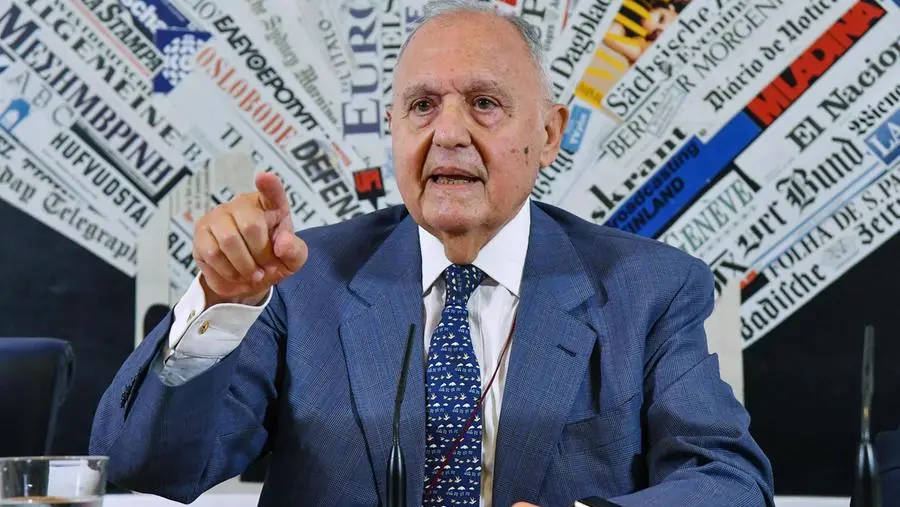


«It is always a great pleasure to return to my university. In Cagliari I find many friends. I have not abandoned my roots ». Paolo Savona, now president of Consob, in the past experiences at the top of banks and Confindustria and the Government, in the role of minister, with Carlo Azeglio Ciampi and more recently with Giuseppe Conte, speaks tomorrow morning in Cagliari, in Room A of the Department of Economics and Business Sciences of the University, at the conference on “The economics of cryptocurrency”. Before addressing the legal and financial implications of the increasingly frequent use of virtual currency, Savona analyzes the real economy. Just yesterday Prime Minister Draghi made a profession of optimism: "There is trust in Italy".
Professor, how do you see the scenario of the country?
«I cannot express an opinion on the Government due to the institutional role I hold. I say that we are all breathing a sigh of relief compared to the fears of two or three years ago. The situation has improved considerably. Thank god".
How useful are the NPRR resources? How much will they be able to support the post-Covid recovery?
“This is the European initiative that I have always dreamed of and advocated as a Minister of European Affairs. They finally got there and this gave me enormous satisfaction. Furthermore, the Recovery and Resilience Plan opens the way for technological innovation and complex infrastructures that can ensure lasting development ».
Innovation and new infrastructures introduce a theme to which you are paying a lot of attention at this stage.
«In 1970, when I was at the Bank of Italy, an econometric model was formulated which proposed an interpretative scheme of the traditional Italian economy. Now I try to come up with a scheme of the same type to be adapted to the cryptocurrency. In recent months at the helm of Consob, I have repeatedly highlighted the need to regulate the cryptocurrency system to prevent a brilliant invention from being, as already happened with derivatives in 2008, the origin of a new crisis ".