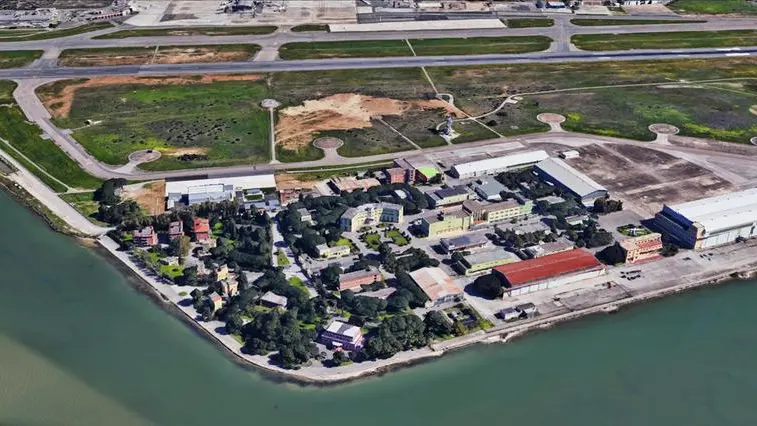


Silence is ghostly. The horizon, towards the murky and agitated waters of Santa Gilla, is broken only by a wall of barbed wire, as much as a lager from the past. The balustrades that separate the water mirror from the citadel of the air, close to the civil airport of Cagliari, fall into dust, corroded by time and neglect. The glorious officers' circle, memory of glories and refreshments, is no longer available to the graduates, now the birds of the pond share it. Here everything was once forbidden: to enter, to photograph, to stick one's nose beyond that war fence. The signs signaled the prohibitions as if, beyond those hope-green cylinders, placed like columns of Hercules at the entrance to the military airport of Cagliari, there was no tomorrow. Just reading them was intimidating, let alone challenging them. Even today everything is forbidden, but there is not a single armed soldier to prevent access to what was once one of the most prestigious air force bases in the land of Sardinia.

Sealed by time
To block the entrance there is only a padlock, attacked by rust and sealed by time. There has been no one in here for four years. As if peace had decided to erase history. Yet this appendix in the Gulf of Angels has marked the history not only of aviation in the Nuraghi Island, but also those of the great crossings, from the admirable feats of the commander Francesco De Pinedo, who departed from here for the "Cruise of the Americas ”, At the beginning of the seaplane connections, in 1927, between Cagliari and the Lido di Ostia, in Rome.