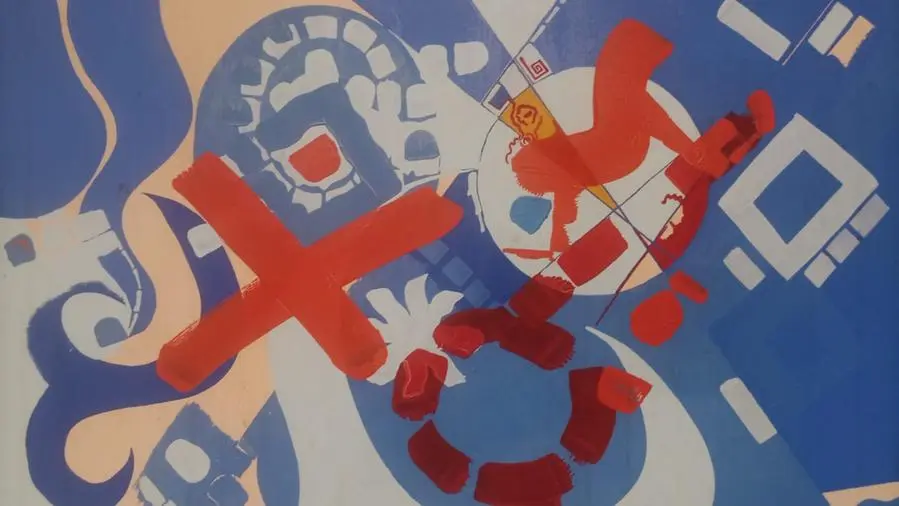


“I was 8 years old, and when I went up to my father's studio in Castello, I met his friends, who, immersed in a smokescreen, squabbled over the meaning of a color or a shape for whole afternoons. I still didn't understand why they fought so much ”.
It happened every Saturday, in the small attic - studio of Ermanno Leinardi, one of the main exponents of the Sardinian Neoavantgarde.
A cross-section of the great cultural and artistic ferment of Cagliari in the 1950s is given back to us by the son of Ermanno Leinardi, Raul, now sixty-five, who recounted many episodes from his father's life during a meeting at the Diocesan Museum, on the sidelines of the anthological exhibition on Leinardi, who disappeared in Calasetta, 15 years ago.
He told about his childhood memories, his emotions and the lessons learned from all those strange people, the protagonists of what was the neo-avant-garde movement in the second half of the twentieth century in Sardinia.
Together with him the curator of the catalog, Maria Dolores Picciau, a friend of the Leinardi family, and the art historian Gianni Murtas.
The meeting, strongly desired by the director of the Diocesan, Silvia Oppo, took place at the end of the exhibition, which remained for a few months in the rooms of the Oristano museum.
But what was the movement of the Neo avant-gardes for the island?
The art historian Gianni Murtas, who answered the questions of Antonello Carboni, co-curator of the exhibition, introduced the theme in a very informal chat, but very popular with the Oristano public.
The scenario is the second half of the twentieth century, the place is the city of Cagliari, the Sardinian capital where a large number of exponents of the island's Neo avant-gardes have concentrated.
“In those years - says Gianni Murtas -“ Studio 58 ”was born in Cagliari, a very heterogeneous group of artists which included, among others, Primo Pantoli, Gaetano Brundu, Ugo Ugo, Rosanna Rossi, Mirella Mibelli and Luigi Pascalis. Young creatives who were looking for a new space in which to confront themselves, and show their differences with respect to the Sardinians of the early twentieth century mainly linked to the figurative, such as Biasi and Figari ”.