









Spain heads to the polls , with a game that is worth far more than the Moncloa vote. Polls open today, Sunday, November 29, from 9:00 a.m. to 8:00 p.m.: 38.7 million voters are called to choose the new Parliament , including 1.6 million young people making their first appearance at the polls: a crucial pool, along with women and undecided voters—estimated at 13%—courted to the last vote in a campaign played on emotion and polarization.
Pedro Sánchez is seeking a fourth term as prime minister, determined to stem the advance of the right and far right. Alberto Núñez Feijoo, leader of the Popular Party, the frontrunner in the polls, is aiming to conquer the Moncloa after his Pyrrhic victory in 2023, which was insufficient to secure his leadership. But, unlike three years ago, he is not shying away from a coalition with Santiago Abascal's Vox party , which aspires to double its support and is ready to hand him the bill if it holds the key to governability, as nearly all surveys indicate. At stake is a historic moment: the far right's return to government for the first time since the end of Franco's dictatorship.
The Socialist prime minister heads to the polls after a troubled term, never legitimized by his opponents, due to the original sin of granting amnesty to Catalan independence activists in exchange for his investiture. Then came the corruption accusations, which did not spare his family, the migration crisis in Ceuta, the controversy over the management of the resurgent influx of migrants to the Canary Islands, and two serious train accidents in nine months, the last one at the end of October, which claimed the lives of 69 people.
A sequence that the PP and Vox transformed into a new referendum on "Sanchezism." Five issues dominated the campaign: the housing crisis, the cost of living, immigration, corruption, and railway safety . Housing itself had triggered the crisis, following the failure in Parliament of the government's emergency package to combat high rents and evictions, rejected by the PP, Vox, and Junts, which prompted Sanchez to bring forward the elections. The prime minister relaunched the campaign, approving, with his left-wing PSOE allies , a raft of social measures, with the Chamber dissolved: from increases in pensions and salaries for public employees to cuts in personal income tax for the self-employed to expanded family leave .
"My government hasn't been perfect. I've made mistakes," he admitted, while still claiming that he's been acting "in the right direction" and contrasting two models of the country: the "red dike" and the impending "black tide." "We are called to make history. And history doesn't come by itself: we are the ones who have to give it a push," he urged at the Caja Magica, closing his election campaign with a kiss to his wife, Begona Gomez.
Popular leader Feijoo promised "truth, decency, and good governance," assuring: "This time, we will not only win, but govern." Challenging Abascal's hard line on immigration, he visited Ceuta, the Moroccan exclave, six times. Even on the day of "reflection" and electoral silence, on the eve of the vote, breaking a long-standing tradition.
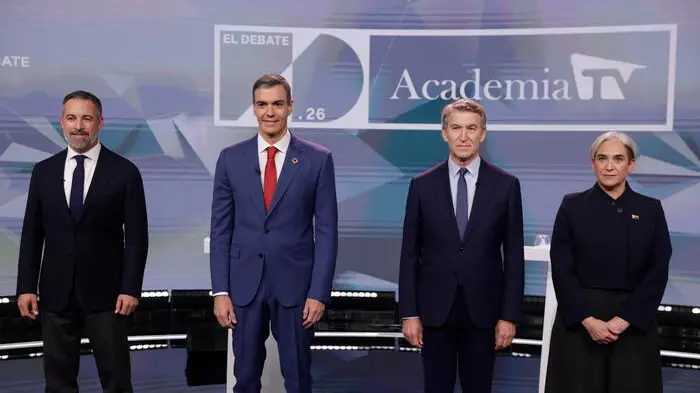
The latest public polls indicate a stable PP, but eroded by a rising Vox party, which has raised issues of "remigration" and the national priority of Spaniards in access to housing and services. Abascal has called on right-wing voters to "vote with courage" to oust Sánchez from Moncloa. But the €112 billion public spending cuts—equivalent to half the annual budget—promised by Vox, like Milei's chainsaw, have frightened many and risk slowing their advance. This is coupled with Abascal's denial of gender violence, evident in his failure to explicitly condemn the four candidates' televised duel, urged by Frente Amplio leader Ada Colau. In the debate, a slip-up could also alienate part of the female vote for Feijoo, who, with his index finger to his nose, told the alternative left candidate, "Shut up!", drawing criticism of "machismo."
"Not only will we not remain silent, we will win on Sunday," Colau replied, relaunching his defense of women's rights and the welfare state. And it is on women's mobilization that the prime minister is hoping for a comeback, running with the Frente Amplio and supported by the same eight parties that gave him their confidence three years ago. But perhaps, this time, without the support of Junts.
(Unioneonline)