

Macciò: "My career is dedicated to my practice and my patients. To them, I say: live in color."
The oncologist is retiring: "Free time? I'll know how to manage my energy." The record number of surgeries at Businco and Brotzu and the ten thousand women operated on: 40 years on the front lines of cancer treatment.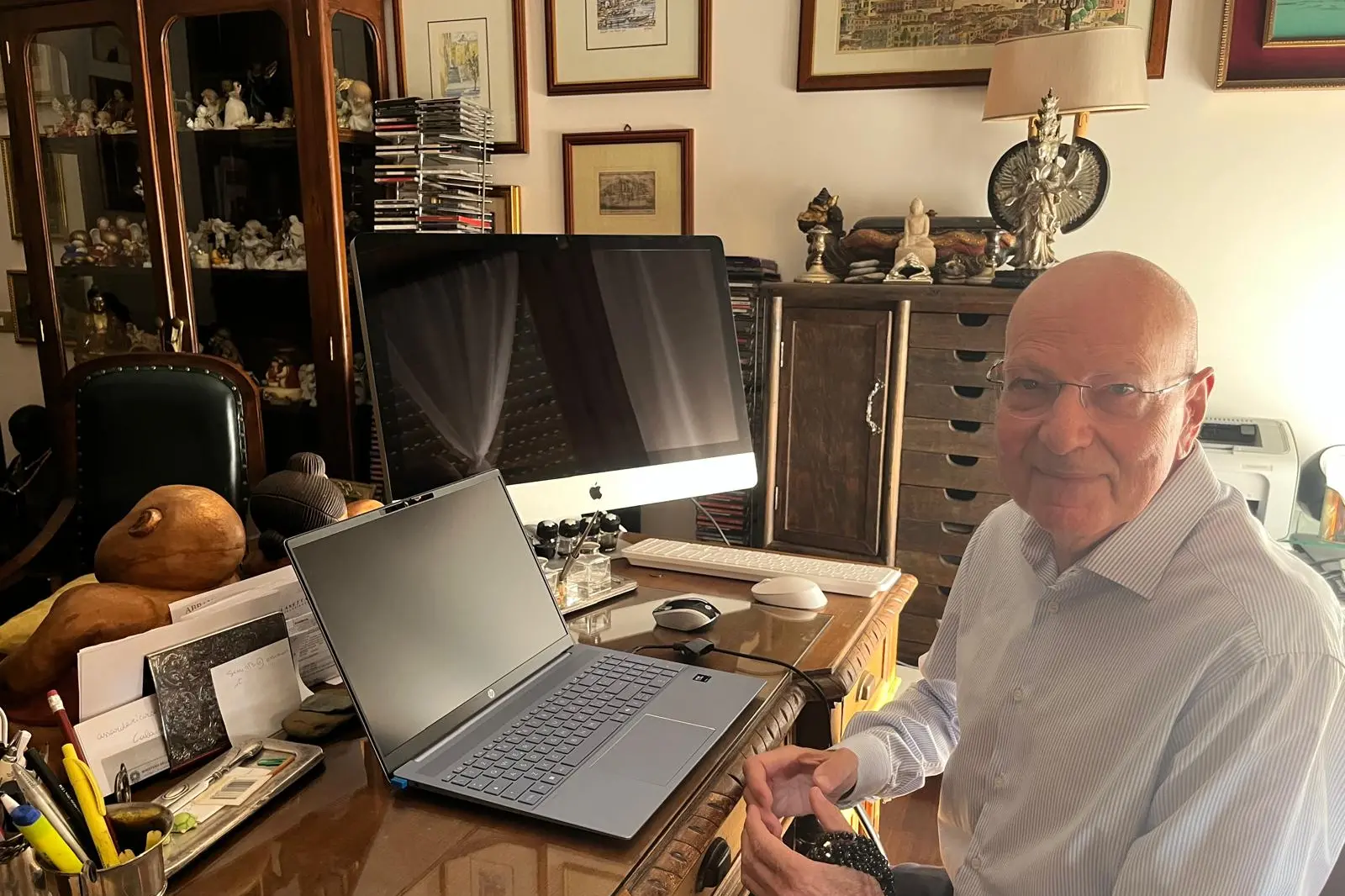
Per restare aggiornato entra nel nostro canale Whatsapp
"It's a phase of life. One of those things as certain as death, if you get there."
Professor Antonio Macciò smiles as he sits at his computer desk in the study of his home in Cagliari. Were it not for the Madonna of Lourdes guarding his back ("I've always had her by my side") and the Buddha presiding over the room (just as he did in the hospital), he might seem almost out of place, given that he's spent the last four decades of his career between the operating room and the outpatient clinic, always close to his patients. He turned 70, a birthday that coincided with his enlistment in the retirement category, an event he—former director of the Complex Unit of Gynecological Oncology at Businco Hospital and a full professor at the University of Cagliari—categorizes among the "technical deadlines of existence."
Professor, it won't be easy to manage so much free time for someone like you, always working in the hospital.
"It's always about planning your energy, that doesn't change, you know? You have to be aware that there comes a time when you can no longer fulfill your institutional role. If you don't reflect on this, you risk falling into depression."
It happens to many.
"This happens because we must never centralize, never make our very being coincide with the institutional role we hold. We cannot allow the two to become one."
Staying focused on the present is one of the pieces of advice she gave her patients…
It's a constant pattern in my life. For example, a year ago I was technically dead (two heart attacks, ed.), and if I had stopped at that dynamic, mulling over the fact that on May 1, 2025, at 8:30 PM, I suffered a potentially irreversible shock, I wouldn't have resumed surgery on July 2, a few months later. But I did, I resumed surgery because I had the patient on the waiting list for that day in mind. I had a goal: to be available for someone else's needs.
He must have slowed down.
"After that May 1st, up until last July, do you know how many interventions I made? 330, an average of one a day. And from May 2025 to last August, I published ten papers, signing them first and last, more than I've ever done in such a short span of time. These papers were published by my department, with the collaboration of a young colleague whom I respect greatly and who also had many problems, demonstrating that being available comes from an internal preparation."
Speaking of availability, it's hard to believe that an experience like yours could no longer be made available to the public.
"If you share your experience, there must be a system that utilizes the wealth of knowledge you represent. A certified wealth, which is not centered on 'I am,' but on 'others say I am.' If, throughout my professional history, publications on ovarian cancer and inflammation have been central to international scientific thought, and if one of my publications has over 400 citations, it means I have contributed to building an understanding of a disease."
Many of his colleagues retire and work in private clinics, open their own practices, or join the public administration in political roles…
A political role arises from a shared political outlook, which can be overridden by technical merit. But I wouldn't want to venture into that territory. I can only say that I possess certifiable scientific knowledge. Having numerous publications is not easy for a surgeon who works extensively in the operating room, because those who have the time usually publish a lot. Between the Oncology Unit and the Brotzu Hospital, having had the time available in the operating room, I operated 40 hours a week and had two days in the outpatient clinic.
His studies focused heavily on immunology, on the relationship between cancer and immunosuppression...
I was fortunate enough to meet Professor Giovanni Mantovani when I was preparing my thesis. Thanks to him, I realized this could be my field. If I know what happens around the tumor, I can understand a lot about the tumor itself, and this is a contribution our work has made to the field of concomitant therapies, supporting the deficient immune system during cancer treatments.
She stressed that cancer is not an alien.
It's not a host, but rather a part of the organism that, for reasons currently being investigated, takes a different path. Cancer grows in an environment it knows perfectly well; it thrives at home, and it uses, sharing with the organism, whatever it can utilize—cells, nutrients, systems, and structures. It's as if it had a program designed to determine the death of that individual, which also entails the death of the cancer. There's a very important relationship with death, which ultimately becomes the topic of discussion.
Death is scary.
We are powerful influencers of our own well-being. That's why I say we must walk with the light, because we know we stumble in the darkness. Positive thinking is the enemy of cancer.
Is there a spiritual component to healing?
Spiritual in the sense that it pertains to the deepest interiority of the person. A reshaping of thought that seeks life, light, love. This is why the constant relationship between doctor and patient, before and after the operation, is important. A capacity for understanding before and after the disease we must treat together.
Hundreds of operations are performed each year, but its pace has been severely tested by the start of work on the Businco operating block and a construction site still at sea.
«However, I continued to work in the available spaces, thinking only of the well-being of the patients».
Which medical advance has truly advanced cancer treatment?
"Certainly the introduction of molecular diagnosis of cancer, that is, the study of histology associated with genetic mutations in the tumor. This paved the way for targeted therapy, that is, targeted therapy. Like a tailor-made suit for the patient."
What do you think about artificial intelligence?
"It's a dangerous tool because you have to know how to handle it. I use it constantly; it's a daily comparison. It's useful, for example, for researching scientific innovations emerging from the most recent publications, but when you question it on a topic you know, you have to guide it."
How many women have you operated on in your entire career?
«Also considering caesarean sections and small operations, around ten thousand».
Beyond medical recommendations, is there anything in particular you've suggested to your patients?
"The healing power of colors. I've always said: dress in the most beautiful colors. I don't like black; it's dark. Colors, on the other hand, are light, a zest for life."
Was there a moment in the operating room when you feared you wouldn't make it?
"So many times. There are clinical cases so complex that it's impossible not to have this fear. But I never gave up. I always tried to find my way in the discipline. Take a breath and go."
Do you consider yourself an excellent surgeon or a great doctor?
"I wholeheartedly say he is a great doctor."
He says it almost shyly.
"Because I know it's disturbing. But if I'd stopped at what disturbs others, I'd never have achieved what I am."
Among others, there are also those who consider it presumptuous.
«I am simply aware of my knowledge».
You've saved the lives of thousands of women, but is there anything you think you've learned about life?
"That you should never challenge death, because it wins. I learned that it exists today and that tomorrow doesn't, that it existed yesterday and yet it doesn't exist today. So I learned that you live each day with those who are there. You live with those who are there, because alone you go nowhere."