

Griffon vulture killed by wind turbine, University of Sassari study: "Here's how to prevent turbine impacts on birds of prey."
The challenge of the Life Safe for Vultures project: constant monitoring and correct territorial planning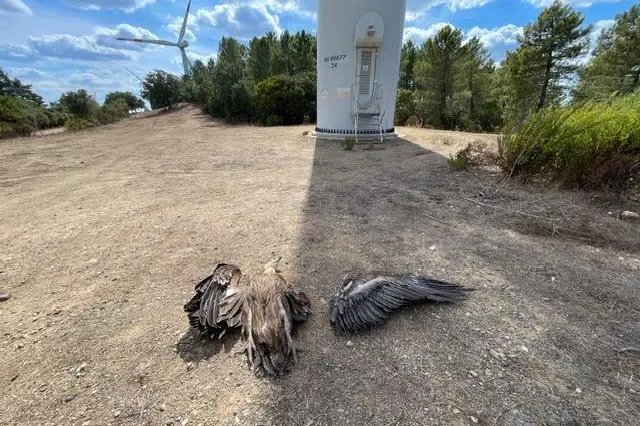
Per restare aggiornato entra nel nostro canale Whatsapp
The death of a young griffon vulture following a collision with a wind turbine in the Monte Grighine park, near Villaurbana, draws attention to a topic destined to become increasingly important in Sardinia: how to support the energy transition while reducing its impact on biodiversity. This is a challenge addressed by the Life Safe for Vultures project, which employs an integrated approach involving the University of Sassari, the Forestas Agency, the Sardinia Regional Forestry and Environmental Protection Corps, E-Distribuzione, and the Vulture Conservation Foundation, combining scientific expertise, land management, monitoring, conservation, and knowledge of energy infrastructure.
"The transition to renewable energy is necessary, but it is not without impacts on the landscape and wildlife . The issue is not to pit energy against conservation, but to have the knowledge necessary to choose where and how to build infrastructure, prevent conflicts, and intervene with appropriate mitigation measures," says Fiammetta Berlinguer, professor at the University of Sassari and scientific director of the project. " Mortality associated with energy infrastructure is the main documented anthropogenic cause for the griffon vulture in Sardinia. The risk affects various types of infrastructure and is addressed by combining animal monitoring, fieldwork, data collection and analysis, prevention, and mitigation interventions." Meanwhile, the population has grown to over 500 individuals, and its distribution range has expanded . "Population growth is one of the most important results of conservation efforts carried out in recent years, but a larger population, using a larger portion of land, comes into contact more frequently with human infrastructure," is the partners' premise. "This requires anticipating conflicts through updated data, monitoring, and appropriate land-use planning," is the challenge. As the University of Verona explains, satellite telemetry, fieldwork, recovery, analysis of mortality events, and analysis of distribution space allow Life Safe for Vultures to reconstruct the animals' movements, track range expansion, and identify areas where the presence of infrastructure may pose a higher risk.
"The project's strength lies in the ability to integrate scientific data and operational knowledge from stakeholders who work daily, with synergistic expertise, on species conservation and land management," states Life Safe for Vultures. Research on the expansion of wind power in Sardinia also fits into this process: the study conducted by the University of Sassari with the involvement of the regional Department of Environmental Protection has helped build an updated knowledge base on the distribution of wind turbines on the island, essential for reliably assessing their relationship with the areas used by the griffon vulture and other sensitive species.
The study reconstructed the evolution of wind energy in Sardinia between 2011 and 2023, highlighting a 118% increase in wind energy infrastructure and a growing overlap between plant development and areas important for various raptor species. For the griffon vulture, the analysis used data collected through years of GPS monitoring, allowing for a comparison of the areas actually frequented by the animals with the distribution of infrastructure. This approach allows for moving beyond static assessments and considering how the territory and population distribution change over time.
A previous study focused on the reliability of infrastructure location information. Satellite imagery identified 1,155 turbines, a higher number than reported by the main available datasets. A subsequent statistical analysis estimated the number of onshore wind turbines in Sardinia at 1,168, confirming the importance of having complete, updated, and validated maps. "These results demonstrate why reliable and shared data must be the basis of territorial planning," the project states. "To assess a risk, it is necessary to simultaneously know where the infrastructure is located, which territories the species use, and how both these components are changing over time." For Life Safe for Vultures, therefore, biodiversity conservation and energy transition are not alternative objectives. " The challenge is to ensure that the transformation of the energy system occurs through territorial planning capable of integrating the needs of species and ecosystems from the outset. Renewable energy is a fundamental component of the energy transition, but renewable does not mean zero impact: sustainability also depends on where infrastructure is located, how it is designed, and the ability to monitor and mitigate its impacts." And in this sense, "the availability of up-to-date scientific data allows us to identify the most sensitive areas and guide decisions toward solutions more compatible with biodiversity conservation."
--