

Geovillage's new life begins with school: 133 students at the Sardinia International School
In just one year, the number of students has more than doubled, going from 60 to 133 enrolled.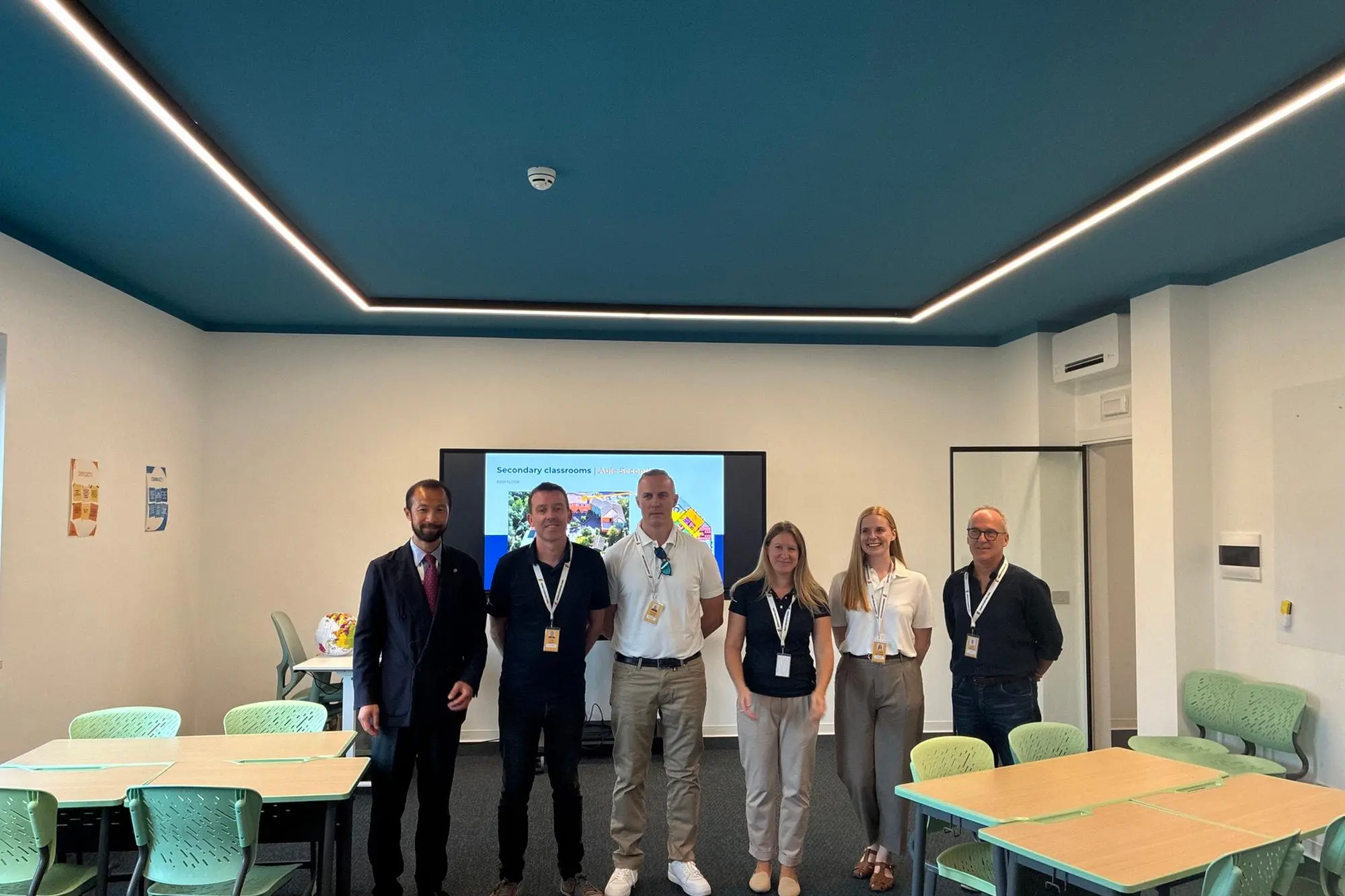
Per restare aggiornato entra nel nostro canale Whatsapp
The rebirth of Geovillage depends, above all, on education, with a qualified, bilingual educational model with a strong international focus. A tangible demonstration of the project's new phase is the growth of the Sardinia International School, which has more than doubled its student enrollment in just one year, from 60 to 133. This result seems to confirm the validity of the challenge undertaken by the Alma Group, which, on the property acquired by Cipnes, is building a fully-fledged university campus with 250 residences, for a total of 464 places reserved for students of the UniOlbia faculties.
During a well-attended open day, attended by children, teens, families, and teachers, the school presented the new features for the new academic year: from the management team to the expansion of the curriculum, to an educational project aimed at making the area a place of excellence and international openness. One of the school's distinctive features is bilingual teaching. As CEO Tony Chan explained, outlining the school's approach, teachers work in an international environment, and students who have attended the school since last year have achieved a good level of English proficiency. The school has also expanded its educational program, opening the private primary school with a first, two second, third, fourth, and fifth grades, in addition to the three classes of lower secondary school. Particular attention is paid to class size, which limits class sizes to 18 students, to allow for a more direct relationship between students and teachers. The spaces, renovated with meticulous attention to detail: LED lighting, sound-absorbing floors, and state-of-the-art digital whiteboards contribute to creating spaces designed for modern teaching. The curriculum differs from the traditional school model in several respects. Problem-based learning and project work are at the core, along with outdoor lessons, sports, music, and workshops.
Among the new features is the "Thinking More" curriculum, designed for middle school students to develop reasoning and analytical skills. The extended hours also allow for a variety of complementary activities to be offered alongside lessons: from robotics to 3D printing, from making to chemistry, and even music education. The goal is to build an educational ecosystem where students can develop not only knowledge, but also independence, creativity, the ability to work in a team, and the ability to address real-world problems. Relationships with families are important, indeed, fundamental, as emphasized by the primary school principal, Chris Moore. Parents are involved in the life of the school and the activities of the educational community. Families regularly participate in workshops and receive resources to help them understand the school curriculum, including dedicated English courses. The plan is to expand the offerings through the middle school cycle.
"We want to be a service to the community and the entire region, and to be open to it," is the message from the school, which presents itself as an open space and invites interested teachers to discover the institute's educational method and approach. SiSchool, as Aldo Carta, general manager of Cipnes Gallura, stated, is part of a vision in which culture, education, and training become tools for development.
During the open day, the Consortium's role was emphasized. It supported a project considered strategic for the area, in the belief that new educational opportunities can encourage the arrival of international students and generate new flows, cultural exchanges, and growth. The investor's vision, in fact, extends beyond the current school offerings. With the construction of a university campus, in collaboration with the Ministry of Universities and Research, the ambition is to build a comprehensive educational program over time, from primary school to higher education and professional training. The vision behind the project focuses on developing new human capital, international and capable of engaging with diverse cultures, languages, and skills. "It's a challenge that begins with the school and focuses on the development of the area," said Aldo Carta, "so we thank the investor for looking beyond business to build a complex system of knowledge and skills, in which education, training, innovation, and internationalization can move forward together."