

Cabras, 900 barefoot runners: countdown to the Corsa degli Scalzi (Barefoot Race)
The official presentation of the event will take place today. Among the new features is the presence of numerous operators who will prevent crowding along the route with safety ropes.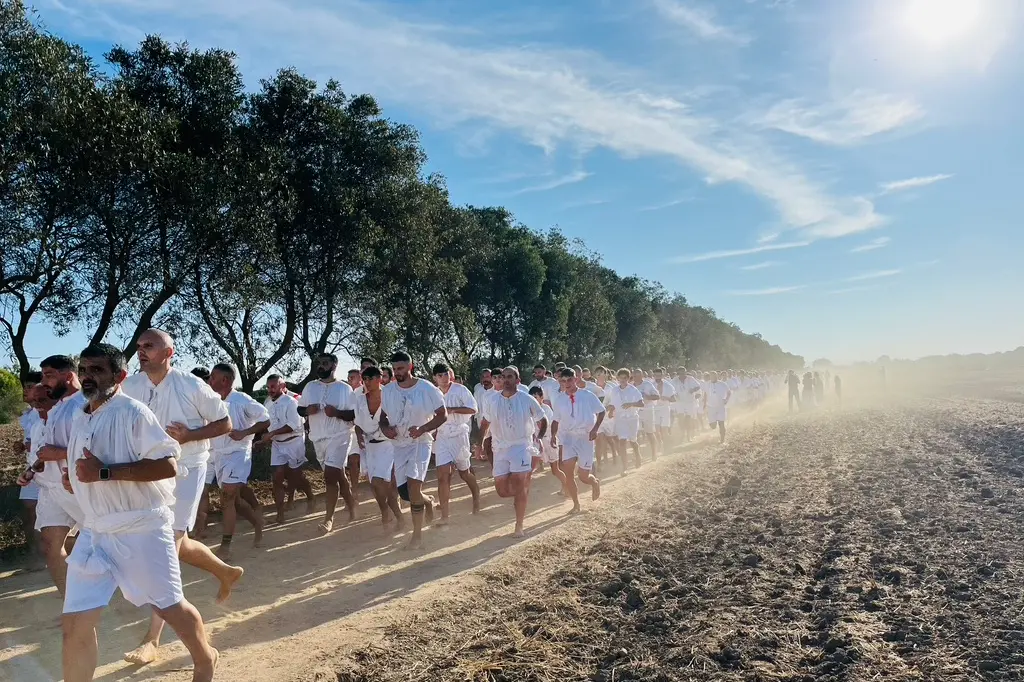
Per restare aggiornato entra nel nostro canale Whatsapp
There's faith, ancient history repeating itself, the magic of ritual, the effort, but also countless tourists who today want to watch the event along the Sinis trails: a way to feel part of that "special" community of 900 runners . This is why today, compared to the past, when spectators were smaller and there were far fewer barefoot runners, the San Salvatore race requires more rules. To avoid endangering those running from Cabras to the village, for the first time there will be several security personnel at the busiest points, such as the arrival of the saint in the village, who will use ropes to prevent the route from being invaded. This is one of the new features of the 2026 edition, announced this morning by the Municipality during the event presentation.
The numbers
Eleven days of celebration, from August 28th to September 7th, in the lagoon town and the village. For the Region, it is one of ten "Major Identity Events ." This is why the numbers surrounding the event are so high: approximately €250,000 will be spent on its organization. €50,000 has been allocated from the municipal budget, €108,000 from the Region, another €20,000 from the Fondazione Sardegna, and €25,000 from the Fondazione Mont'e Prama. And then there are the resources provided by the committee for the civil celebrations.
The party
"Behind the Corsa degli Scalzi lies the soul of an entire community, and the administration is working to ensure that events like this become increasingly safe and accessible," explains Mayor Andrea Abis . "The Festa per San Salvatore is first and foremost a popular celebration, a celebration of religious tradition, which we want to share without ever falling into the temptation of spectacularization. It's a true opportunity to experience the profound culture of the Sinis, our soul, our history, and our living traditions. Over the years, visitors have grown in number, curious to learn about and connect with our community, and this makes us proud and comforted. We are, in fact, convinced that the model we are focusing on is a winning one: growing the economy of our territory while protecting and preserving our identity." Councilor for Mobility Enrico Giordano commented on safety: "There will be approximately eighty people involved in security operations. Everyone's professionalism and cooperation will be essential, as will keeping the route clear and preventing cars from entering the area. This year, the Association has made an additional request: to help ensure the procession is respected during key moments, such as the arrival at the village and the arrival in Cabras, including the entrance to the church. We have therefore decided to ensure safety with a system of cordons managed by staff, which will be gradually removed and dissolved into the crowd as soon as they are no longer needed. Furthermore, in San Salvatore, poles have been installed to mark the boundaries of the area reserved for those attending the start and finish, while the final stretch will be equipped with anti-tip barriers, further ensuring everyone's safety.
The women
As always, it will be the women, 500 in total, who will be doing the dancing in April. On Friday, August 28th, barefoot and dressed in traditional attire, they will walk the seven kilometers of su camminu de su Santu, carrying Santu Srabadoeddu , the small, ancient statue of the Holy Savior, from the village to the rural village. A ritual revived in 1981 by some devotees, it remains one of the most intimate moments of the festival: songs and prayers in Sardinian intertwine with the pace and the effort, until they reach the sanctuary, where the statue will be kept for the entire novena. "We will walk barefoot as our mothers and grandmothers did, carrying Santu Srabadoeddu along the same path. It is a silent gesture, a dialogue between us, those who came before us, and the Saint," comments Maria Francesca Spanu of the Santu Srabadoeddu association.
The race
To see that human river dressed in white, however, you have to wait until the morning of September 5th. The Scalzi, after the 6:00 a.m. Mass, presided over by Monsignor Roberto Carboni, work the parish church of Santa Maria in procession towards Via Tharros. At 7:30 a.m., the Curridoris will begin their race to transport the statue of San Salvatore to the village, crossing dusty paths of the Sinis. It's a way to remember when a group of fishermen and farmers managed to save the statue from Saracen raids. At 8:30 a.m., they arrive in the village. "Our association exists to preserve this moment with order and devotion: seven kilometers of sacrifice, of intense prayer, and intimacy with our Savior Jesus, which are also a metaphor for life. San Salvatore represents Easter in the journey of faith of every runner," comments Alessio Camedda, president of the Is Curridoris association of San Salvatore. The following day, Sunday, September 6th, at 6:30 p.m., the Saint returns to Cabras.
The civil celebrations
But not just faith. Alongside the religious program, the village of San Salvatore will change its appearance every evening: it starts on Friday, August 28th with Dantzas, a festival of traditional dance and music featuring the Cogar Celi Band (Ireland), the Balbrulè (Veneto) and the Sardinian Ballade Ballade Bois, with the participation of launeddas master Stefano Pinna. This is followed by roast porchetta and a concert by Naracauli (August 29th), the Frittura di paranza Festival with Fantasias de Ballos (August 30th), theatre with Daniele Contu (August 31st) and the Compagnia Arriora (September 1st), a demonstration of ancient arts and crafts by Artis Antiga and the music of Sonus de Festa (September 2nd), and an evening with Giuliano Marongiu (September 3rd). On Saturday, September 5th, in addition to the Race, there will also be the Mullet Festival, the Boes e Merdules of Ottana, and a concert by Cordas et Cannas. The grand finale is Sunday, September 6th in Piazza Stagno, with a fireworks display and a concert by Baby K. "One of our goals was to liven up the village throughout the evenings, paying special attention to traditional events such as Sardinian comedy and traditional dances," explained Roberto Matta, president of the San Salvatore 2026 Committee . "We worked hard to create a program that engages everyone, including comedy and music, with the goal of engaging young and old, locals and visitors alike. A special feature of this edition will be the first day of the festivities, with a traveling festival of traditional dances and music that will bring the beauty of intercultural exchange to Cabras through music, also featuring an Irish group. It will be an opportunity to meet, share different cultures, and discover how traditions, even though they belong to distant places, can speak the same language."
Accessibility
The most vulnerable spectators will receive special attention: a 200-seat grandstand will be set up on Via Tharros , free and accessible until capacity is reached, reserved for seniors, pregnant women, and vulnerable people, with a dedicated platform for those with mobility disabilities. Also on Via Tharros, near the finish line, a system of poles and cordons will ensure the safety of runners and worshippers. Those unable to be in Cabras will still be able to follow the celebrations: on Saturday, September 5th and Sunday, September 6th, the social media channels of the Municipality of Cabras and the official Corsa degli Scalzi page will broadcast the start and key moments of the religious ceremony. On Sunday, September 6th, for the return leg, TeleSardegna and Aristanis TV will broadcast simultaneously from 6:00 PM to 8:00 PM.