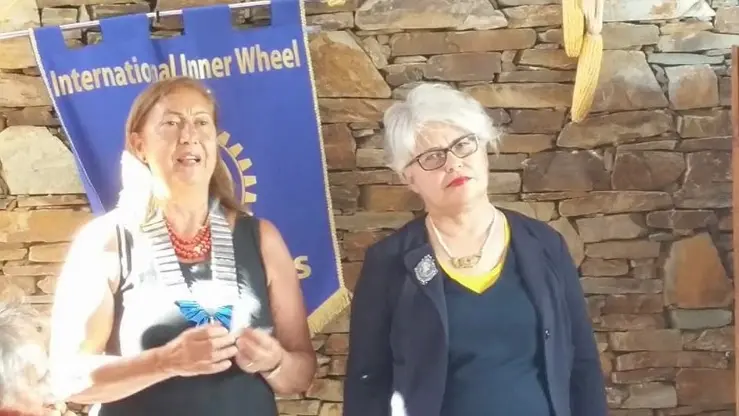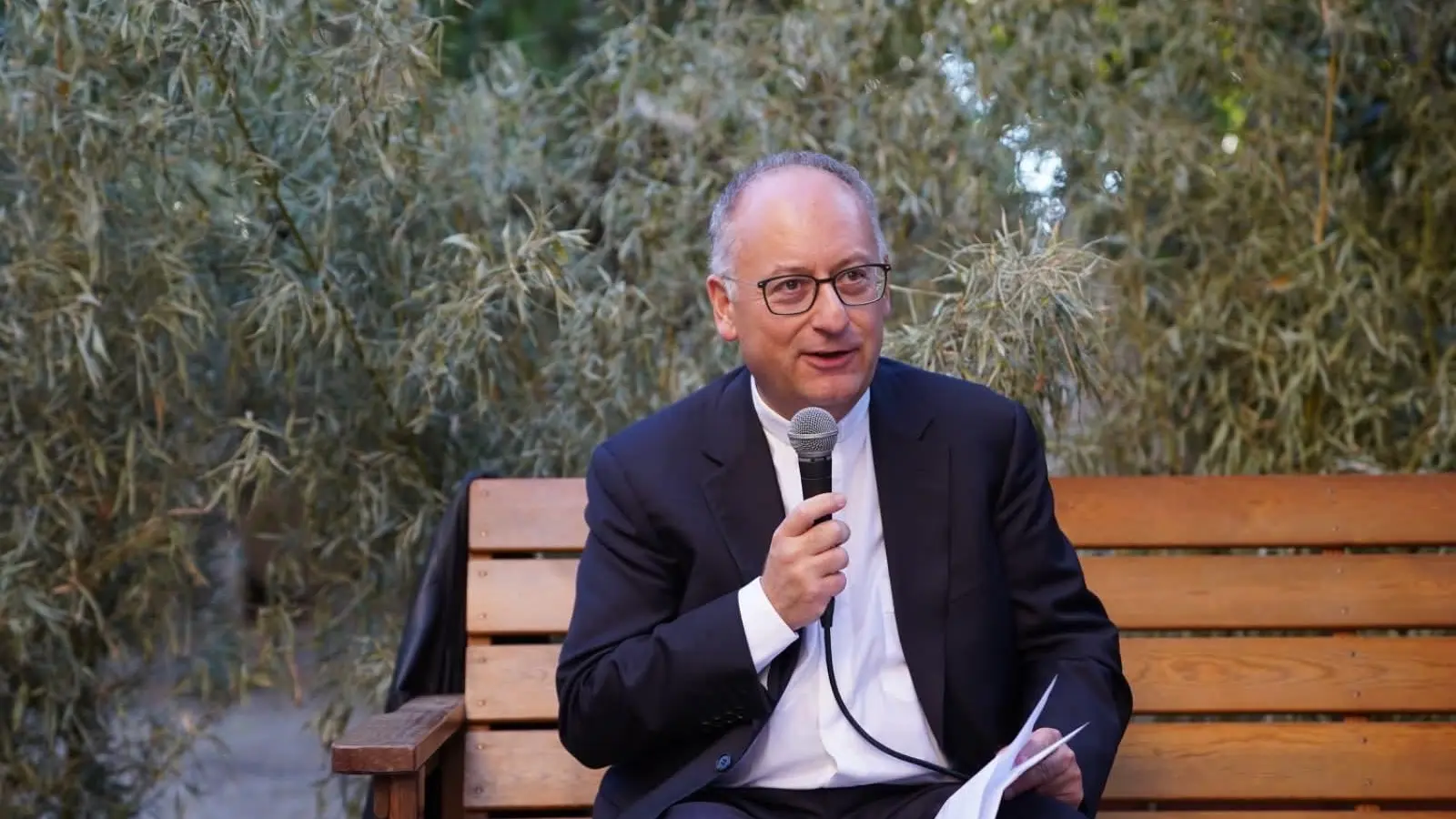


On the occasion of the twelfth edition of the Cultural Tourism Expo in Sardinia, the "Barumini Award – the Betilo for Culture" was awarded to Antonio Spadaro, Jesuit, journalist, theologian, and undersecretary of the Holy See's Dicastery for Culture and Education. Below, we publish his speech, titled "Animated Stones."
*******
I thank the Barumini Sistema Cultura Foundation, its president, and those who bring it to life every day; I thank the mayor and the community of Barumini, and all of you here. Receiving an award in front of Su Nuraxi requires a certain sobriety: these stones have stood for over three thousand years and have heard so many words. Mine will be few, and I would like them to be, first and foremost, a way to say thank you.
The first thanks goes to a man who is no longer with us but remains present here every step of the way: Giovanni Lilliu. If a cultural award is being presented here today, it's because someone had the patience to remove the earth, layer by layer, until the stones began to speak again. Because stones speak.
I too, with much less patience and using only my pen, attempted to take the side of these stones, writing an article in December 2020 in La Civiltà Cattolica, of which I was then editor, on the importance of recognizing the nuraghe as a UNESCO World Heritage Site. I wasn't starting from scratch. In 1886, another Jesuit, Father Alberto Maria Centurione, had devoted a long series of articles to the nuraghe in the same journal, "Recent Studies on the Nuraghe and Their Importance," collected in a volume two years later. Centurione admitted that the many studies seemed to him "flashes of fleeting clarity likely to leave the nuraghe in a chaos of conflicting opinions," yet he urged Italy to keep "its gaze fixed on its Sardinia, crowned as it is with towers that have defied the centuries." La Civiltà Cattolica has reprinted that volume in a facsimile edition.
The award is named after the betyl, and I wondered what it meant to receive it. The betyl is a sacred stone. In Sardinia, they are still found standing next to the giants' tombs.
The name, according to an ancient tradition, derives from Beth-El, "house of God," and is a word from the book of Genesis. Jacob flees, he is alone, and the night surprises him in some random place. He takes a stone, places it under his head, and falls asleep. He dreams of a ladder connecting earth to heaven. Upon awakening, he says, "Surely the Lord is in this place, and I did not know it." Then he raises that stone, pours oil on it, and says, "This stone, which I have set up as a pillar, will be a house of God." A stone used as a pillow becomes the sign of an inhabited place.
There's more. Philo of Byblos, a Greek-speaking Phoenician writer known to us through Eusebius of Caesarea, says that betyls were invented by Heaven, and he calls them stones endowed with souls. Animated stones.
I would like to start from here: from the idea that a stone can have a soul, and that creating culture means realizing it.
The twentieth century has given us the opposite image. Giuseppe Ungaretti, wounded in his soul in the trenches of the Carso, found no more accurate image of his own torment than the stone of San Michele: so cold / so hard / so drained / … so totally / lifeless. Stone, as the zero point of life, is the exact opposite of betyl.
A sculptor responded to Ungaretti here in Sardinia. I owe it to Pinuccio Sciola, from San Sperate. When I first arrived in his Sound Garden, among the citrus groves of Campidano, Sciola gave me new ears to listen to the world. I saw on video the gesture with which he placed his hands on his sculptures: he caressed them, as one might touch a face. And the stone rang.
Hearing that sound shatters the belief that stone is silent and inert. He carved the basalt and limestone, the stones of the nuraghi and menhirs, with thin, parallel cuts, until they vibrated. Sciola read the stone's source code and rewrote it: a hacker with a chisel. Basalt, born of fire, sounds hollow like a cello made of lava; limestone, born of the sea, retains the liquidity of its origin in its sound: water stones, he called them.
"In the beginning was the sound," he repeated, paraphrasing the Prologue of John: if the Word is at the origin of everything, the sound that sleeps in the stone is its trace imprinted in matter. And he added: "I don't know if I discovered the stones, or if they discovered me." Sciola's stones are betyls: stones in which a presence demands to be heard.
Why should all this concern us today? Our future races ever forward, measured in updates and versions, nourished by the probable, and no longer able to stop. Yet, this future, too, is made of stone. The silicon in our processors comes from sand and quartz. We have taught stone to calculate. The question, then, is not whether to return to the Stone Age, because, in a certain sense, we never left it. The question is which stone to interrogate, and how.
Cinema understood this before philosophy: at the beginning of 2001: A Space Odyssey Kubrick plants a black stone monolith at the dawn of humanity, and from contact with that silent stone intelligence springs.
The chip, if left to pure algorithm, is a silent stone that calculates the probable; Sciola's stone sings of the possible. The possible sleeps in the real as sound sleeps in basalt, waiting for a hand to awaken it. Rediscovering the courage of the Stone Age means asking matter not for prediction, but for revelation. Sciola buried his monoliths as "seeds of peace," convinced that planting one and watering it would bring it back to life. The archaic, thus understood, is a seed. To imagine is to remember forward.
It's no coincidence that this is so clear here. Sardinia is a privileged place to contemplate the future precisely because it is the land of an archaic past. The nuraghes and menhirs, the giants' tombs, the domus de janas, which have been a World Heritage Site since 2025, are presences, not ruins.
Then there are the sacred wells, dug into the rock down to the living water of the spring, beneath a vault oriented to the lunar cycle. They are inverted temples: instead of soaring toward the sky, they sink into the earth to reach the origin. There, the future is drawn by descending below, where the stone guards the source. "Noli foras ire," wrote Augustine: do not go out, return to yourself. Here that phrase is engraved in geology. And I return to that name, "Sa Funtana," that the farmers of Barumini gave to the Su Nuraxi hill.
The island also preserves what Nietzsche called the Dionysian, the music that rises from the depths and dissolves boundaries. It can be heard in the Mamuthones of Mamoiada's strides, punctuated by the clanging of cowbells; in the tenore singing, which makes the throat vibrate like a Sciola stone; and in the launeddas, pipes that were already a sound in the days of the Nuragic bronze statuettes.
The Foundation wanted this award to go to those who contribute to spreading knowledge, creativity, and the identity of local communities. Receiving it, I think of identity as the well builders understood it: a source from which to draw, reached by descending, and open to those who thirst. An identity that becomes a wall ceases to sing.
Even faced with the rubble of our time, and there is much of it, of stones and lives, we must seek in the stone the sound of a possible new beginning.
Antonio Spadaro