LEGGI IL QUOTIDIANO
LEGGI IL QUOTIDIANOOggi 12 novembre
L'Unione Sarda.it
Abbonati
ITA|ENG|DEU|RUS|CIN
videolina Linkradiolina linkSardegna 1 linkVai online linkPBM link
Temi caldi di oggi:
Allarmi bombaMigrantiTentato omicidioSos Sardegna
Leggi il quotidiano
L'Unione Sarda.it
Abbonati
L'Unione Sarda

Iniziative Editoriali

  • Biblioteca dell'identità

Account

  • Gestisci il tuo abbonamento
  • Sfoglia il quotidiano
ABBONATI A L’UNIONE SARDA

SCARICA L'APP L'UNIONE DIGITAL

Download GoogleDownload apple
videolina Linkradiolina linkVai online linkPBM link

2021 L'Unione Sarda S.p.A. Tutti i diritti riservati. É vietata la riproduzione, anche parziale e con qualsiasi mezzo, di tutti i materiali del sito. | Indirizzo della Sede Legale: Piazzetta L'Unione Sarda nr. 24 | Capitale sociale 11.400.000,00 i.v. | Codice Fiscale ed iscrizione presso l'Ufficio Registro Imprese di Cagliari 01687830925 (P.I. 02544190925) | REA: CA-136248

Cookie e Privacy PolicyModifica impostazioni privacyInformativa commentiCorporate
L'Unione Sarda

News

  • Cronaca Sardegna
  • Economia
  • Salute
  • Cultura
  • Sport
  • Gossip
  • Turismo

Servizi

  • Necrologi
  • Annunci
  • Pubblicità

Bella Sardegna

  • Spiagge

Iniziative Editoriali

  • Biblioteca dell'identità

Account

  • Gestisci il tuo abbonamento
  • Sfoglia il quotidiano
ABBONATI A L’UNIONE SARDA

SCARICA L'APP L'UNIONE DIGITAL

Download GoogleDownload apple
videolina Linkradiolina linkVai online linkPBM link

2021 L'Unione Sarda S.p.A. Tutti i diritti riservati. É vietata la riproduzione, anche parziale e con qualsiasi mezzo, di tutti i materiali del sito. | Indirizzo della Sede Legale: Piazzetta L'Unione Sarda nr. 24 | Capitale sociale 11.400.000,00 i.v. | Codice Fiscale ed iscrizione presso l'Ufficio Registro Imprese di Cagliari 01687830925 (P.I. 02544190925) | REA: CA-136248

Cookie e Privacy PolicyModifica impostazioni privacyInformativa commentiCorporate
Home
The interview

“Don't die of hierarchy”, a journey into the backbone of our organizations

In Marina Capizzi's book an in-depth analysis of the hierarchies that have characterized our society
Roberto Roveda
13 dicembre 2023 alle 10:08
“Don't die of hierarchy”, a journey into the backbone of our organizations
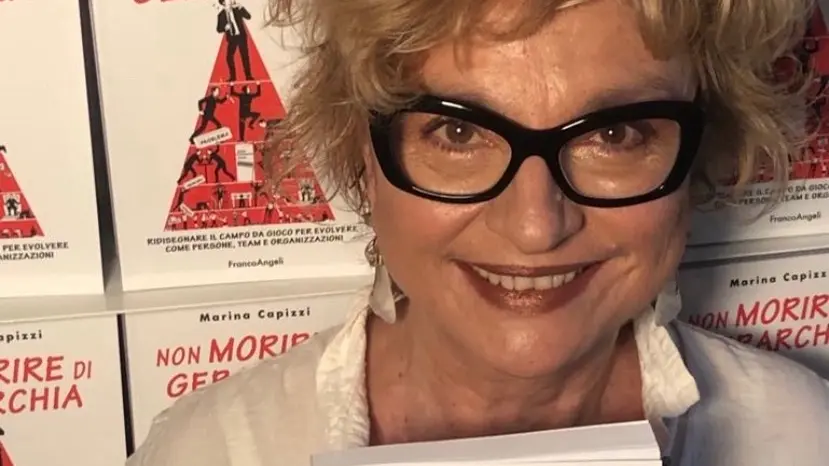
Marina Capizzi (foto concessa)
Resta informato su WhatsApp
FacebookXLinkedInWhatsApp

We often talk about leadership but never about hierarchy. While leadership deals with behaviors, the hierarchy of distribution of decision-making power. Hierarchy, not leadership, creates the real playing field on which we operate. And we know this because, in our workplaces, we breathe hierarchy every day. And we know that it has important effects on both our well-being and our work. Indeed, we often entrust the monitoring of the efficiency and stability of our organizations to hierarchical structures. Sometimes with discouraging results from the point of view of results at work, personal motivation, serenity and quality of life. But: who could even imagine doing without hierarchy within an organization? It would be chaos. Indeed.

Marina Capizzi in the volume "Non die di hierarchy" (Franco Angeli Editore, 2023, pp. 268, also e-book) does not describe a world of work - and not only - deprived of hierarchical structures, but the question that arises and which engages the reader is: what prevents us today from going beyond the hierarchy and making it evolve? Thus begins an exciting journey that leads us to explore the hierarchies that we have known so far, in the two and a half million years of our stay on the earth, hierarchies created to survive in the present and to defend ourselves in the future, which are still the supporting structure in our organizations.

But is the hierarchy we know the only possible form? And first of all, do we really risk dying of hierarchy as the title of the book in a certain sense suggests? We ask Marina Capizzi :

«Yes, because we tend to consider hierarchy, as it comes to us from the past, an inevitable and immutable structure. The mere thought of getting involved makes our wrists tremble because we think that the alternative to hierarchy is chaos. Therefore, even if we experience the limits and costs of this backbone of our organizations every day, we tend to consider them inevitable, almost "natural" problems, while they are the direct effect of a hierarchy that is inadequate to the times. Any examples? The slow decision-making that derives from the fact that autonomy is concentrated only on managerial roles. The demotivation of those at the bottom of the pyramid who 'are not paid to think'...".

© Riproduzione riservata

Argomenti similiSLOT_11
  • Da che parte sta?
    Caffè Scorretto

    Da che parte sta?

    Tacitus

Articoli correlati

Bomb scare, schools aren't closing. Meloni: "They want to scare us, not hit us. We'll react."
the emergency

Bomb scare, schools aren't closing. Meloni: "They want to scare us, not hit us. We'll react."

The prime minister called on the opposition and reassured them in a video on social media: "Nothing was found in the institutions. Those who send these threats want a nation that is terrified and fea…
Majority summit: "Forward with the statute, but no changes to the electoral law."
region

Majority summit: "Forward with the statute, but no changes to the electoral law."
The draft is ready and at the next session the special commission will begin examining all the articles.
Roberto Murgia
Grillo's appeal, the defense: "Evidence in our favor was ignored or undervalued, the trial must be retried."
Sassari

Grillo's appeal, the defense: "Evidence in our favor was ignored or undervalued, the trial must be retried."

In the grounds of appeal, a flurry of objections raised by the lawyers to the regularity of the conviction sentence of the Tempio Tribunal
Andrea Busia
Girasole: Mosquitoes test positive for the Usutu virus: Mayor's order comes into effect.
the alarm

Girasole: Mosquitoes test positive for the Usutu virus: Mayor's order comes into effect.

The verdict from the Teramo zooprophylactic institute is the first case in the municipality.
Roberto Secci
The eighteenth edition of the Carbonia Film Festival kicks off
cinema

The eighteenth edition of the Carbonia Film Festival kicks off

This morning, the Skan mural was unveiled at the ticket office, and the festival officially opens this afternoon. The event will get into full swing in the coming days.
MARCO CORRIAS
Salerno, a new adventure in the Eccellenza league: he will coach the Tortolì women's team.
soccer

Salerno, a new adventure in the Eccellenza league: he will coach the Tortolì women's team.

The 42-year-old coach returns to the bench, in a completely different context than those he has faced so far
Roberto Secci
Kimi Antonelli with his tricolor hair, Mercedes: "No words."
the champion

Kimi Antonelli with his tricolor hair, Mercedes: "No words."

In the video posted by the team, Kimi arrives at the headquarters, Wolff is incredulous: "Did you even pay?"
Costa Smeralda, the "emery gang" and thefts from dream villas: crimes prescribed after 16 years
Olbia

Costa Smeralda, the "emery gang" and thefts from dream villas: crimes prescribed after 16 years

In 2010, raids took place in Porto Cervo and Olbia, with the villa of an undersecretary of Labour and the residence of a Roman countess also targeted.
Andrea Busia
Ciro Grillo trial: appeal faces immediate risk of postponement
court

Ciro Grillo trial: appeal faces immediate risk of postponement

The defense: "A judge's signature is missing; the first-instance ruling must be retried."

Why is it so difficult to change our concept of hierarchy?

«First of all, because all of us were born and trained within a hierarchical logic that provides for the separation between those who think/decide/plan/control, and those who do. In fact, it still seems normal to us that those 'above' tell those 'below' what they have to do, just as it seems natural to us that control should always come from above. Secondly, because we have many certainties and ideologies about the hierarchy but we reflect little: those who defend it with drawn swords and those who fight it as a source of privilege and injustice. In reality, we couldn't do without hierarchy because it helps us create order based on the criterion of importance. This is why we continually produce hierarchies of concepts, priorities, values, affections... The problem is that in organizations we cultivate and recognize only one hierarchy, that of power which increases as we go up the pyramid. But there are many other hierarchies that we can cultivate."

<p>The cover of the book</p>

Which?

«The hierarchy of competence, where the most expert decides; hierarchies of proximity to the problem, where whoever has the problem in front of them decides; hierarchies made up of teams where people decide together: for example, how to organize work, manage peak moments, make small continuous improvements, welcome customers better...".

In the book he talks a lot about fear and the need to lower the costs of fear. But what does he mean exactly?

«The hierarchy is a simple structure: one person commands, and the others obey. This pattern, which has allowed us to survive for millions of years in a dangerous and resource-scarce world, is based on fear. Scaring those below is a tool for exercising power that has always been used by those 'above'. But today's world is too complex to be managed only by those in charge. To grow and develop, companies need thinking people who take charge and contribute at all levels of the organization. To do this, people must be able to expose themselves, take risks and transparently share their mistakes, to learn together with colleagues how to avoid them in the future. All practices that clash with traditional hierarchical logic where people are only called to obey. Today, developing obedience instead of competence puts businesses at risk."

Why is the team so important and what does it have more than the individual?

«The pyramid is based on individuals: individual roles, individual objectives, individual awards (when there are any), individual careers, etc. But people alone can't accomplish much. Everything we accomplish we accomplish with others. A group of people working together (in shops, branches, offices, production units) possesses a wealth of information and skills which, if they were put together and oriented towards a common objective, would produce much more than what other people can produce. single individuals. And this would make people grow and also improve the products and services provided by companies, generating motivation and making the company more competitive."

In the book he also talks about culture, or rather the need to redesign it. In what sense?

«Every social system (family, business, country, etc.) generates a culture, that is, a set of common mental, value and behavioral approaches. However, it is not certain that the current culture of a social system is the most suitable for the future. Redesigning the culture means first of all bringing out the purpose, that is, what the company wants to give to all its interlocutors (customers, employees, shareholders, suppliers, communities and the planet) through the exercise of its business, that is, through the sale of its products and services. In the modern world, the purpose is the first 'hierarchy' that must guide all the choices made at every level of the organization, because it is the raison d'être of the company which, if it is modern and in step with the times, is certainly an economic system but also a tool for generating well-being for its stakeholders. Then the purpose must be translated into values and rules and, finally, into the daily behaviors that translate them into concrete actions. Purpose, values, rules and consistent behaviors are the core of the culture. If you want to evolve the hierarchy, however, it is important that companies, or any other organization, redesign their culture by involving all their people. In my book, “Don't die of hierarchy”, I talk about two companies that have followed this path: the Credem Group and Fidia Farmaceutici».