

Muralism and Cultural Identity, the project promoted by the Municipality of Villamar, with the support of the Fondazione Sardegna, the Autonomous Region of Sardinia-Department of Cultural Heritage and Activities and the organizational coordination by the Association of Local Authorities for Cultural and Entertainment Activities, was presented in recent days in the conference room of the Sala Maiorchina in Villamar.
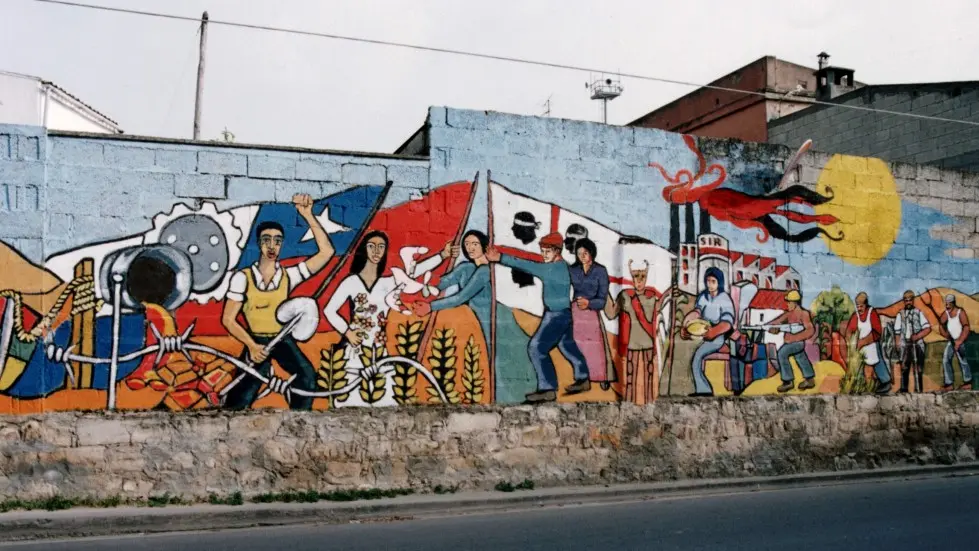
It is a three-year project that aims to protect, conserve and enhance the mural heritage, born on the initiative of the youth movements of the 70s, present in the town of Villamar . The painted walls, recalling political and social values as voices that speak of roots, struggles and sacrifices, simple life and beauty, have managed to pass on that collective memory that is the heart and soul of the community. "The presence of murals in the town contributes to strengthening the local identity and cultural awareness", says the mayor Gian Luca Atzeni.
On this basis and on the belief that culture is the indispensable engine of the life of a community, we intend to act through an approach that integrates both the restoration of historical works and the creation of new ones. The first step involves the census of all the murals present, carried out with scientific criteria and entrusted to Asteras, a cultural association of associated professionals who have been working for years with particular attention to the phenomenon of island muralism . The creation of the inventory will be a useful tool for identifying the murals of greatest historical-artistic value that will be the object of subsequent safeguard interventions.
The restoration, with the collaboration of expert restorers, will include conservation and restoration practices, becoming the first town not to carry out repainting of the murals . All with the involvement of local artists, and citizens who, through public meetings, will be able to propose ideas and suggestions on the new murals.
«Muralism is an art that is born on the street, an art of the people that has the power to connect the past, the present and the future», says Franco Nonnis, artistic director of the project, underlining the .