











It is time to take stock. And the heaviest, surprisingly, seems to be the one that precedes and accompanies the choice of the next President of the Republic, not only because this same choice has become the functional epicenter of accommodation of the party structures, or at least of what remains of each of them, but also to be, that same choice, progressively become a guarantee of survival in the context of a "system" which has become incapable of submitting itself, in the privileged context of the ballot box, to democratic confrontation with the Sovereign People.
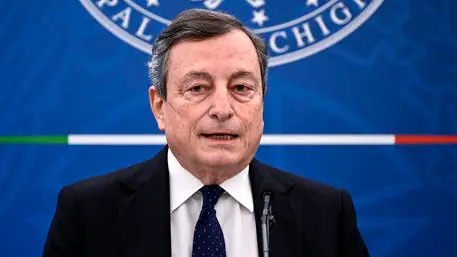
The intent is not to question at all costs the (in) established order of the last two years of the pandemic, nor to prepare a programmatic manifesto on how to proceed. Rather, it is a question of acknowledging, with a precise sense of pragmatism, the progressive affirmation of a controversial society, that of the institutionalized social "no", which seems to have become the significant, fitting and conditioning paradigm of political action. Never before, not even at the time of the (in) glorious ("for many but not for all") First Republic, have we been able to see the collapse of party roles and institutional functions, their detachment from the real country, and the indeterminacy of their representative capacities recently resulted in the formation of a Government of National Unity under the absolute and "absolutist" leadership of Mario Draghi, in his role as "alter ego" of Mario Monti.
Well: that same indeterminacy is significant as to how, outside of a qualifying government presence, both the right and the left, without even passing through the center, non-existent "de facto" although one wants to even try to resurrect that "beelzebub ”By Matteo Renzi, move without any concrete political project and capacity for social mobilization. The limited consent to the state, respectively estimated in the illusory terms of the very close probing verisimilitude, fails to touch, and I add paradoxically, the social and economic issues that should have and should permeate government action.
Whether it is a "representation deficit", or more generally, a sort of reflected "democratic deficit" does not matter. What matters, however, is that in whatever direction you want to turn your gaze, you are no longer able to understand "who" represents "what", that is, the so-called "reference electorate" has been lost as a direct and conscious user of a well-determined political proposal , however, it too, upstream, is deficient.








