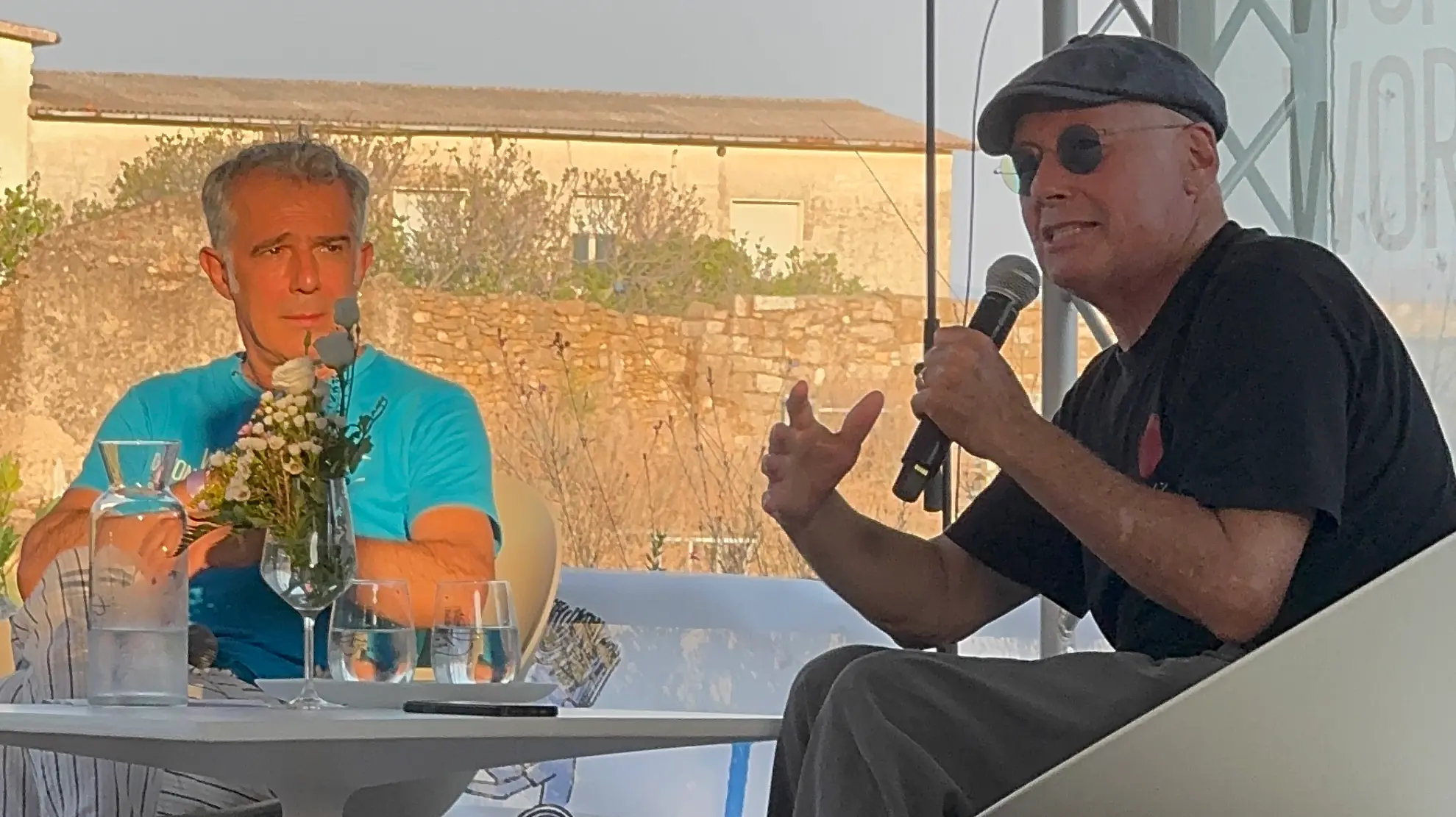


Berchidda, evening of August 14th. Paolo Fresu and Alessandro Baricco are on stage at Time in Jazz, at Sa Casara. Not just a musician and a writer: two men who explored music from different angles, intertwining their memories.
Alessandro Bergonzoni, who was absent at the last minute, was supposed to be there, but his replacement wasn't a stopgap at all. He was already in Berchidda, invited by Fresu, who reminded him that otherwise "it wouldn't have been easy to leave here." The invitation was accepted, with a knowing smile.
"Music encompasses everything," says the island artist, introducing Baricco. In his books, he recalls, there's always a rhythm, a sound that accompanies the words, almost as if they were written to be listened to as well as read. Baricco smiles and quotes Umberto Eco: "He always said: trust Wikipedia. But if it concerns you, you'll only find inaccuracies. I don't have a conservatory degree, nor am I a saxophonist, as it says. I've been playing the piano a little for years, and poorly. But I put music everywhere: it was my way of mourning the loss of that talent."
From that grief, who knows, a book was born, then a film: Novecento. A story of ghosts, of transatlantic love, of pianos dueling with the world. "Jazz," he explained, "was born from migration, from the encounter between Africa and New Orleans. Migrations have always generated wonders. Novecento was born that way, like a bit of jazz."
The conversation is sincere and nuanced. Fresu recalls his trumpet stored in a suitcase with the acrid smell of piston oil, his mother handing it to him after much longing, and him traveling across town so everyone could hear about it. The bands, the weddings that in Berchidda lasted a week, the concerts in neighboring towns, his discovery of jazz in the late 1970s. "For me, happiness was leaving home and going to the rehearsal room. My fortune was the band, a community that helps you grow. I learned there that music is about sharing."
Baricco offers another image, distant yet mirrored: the Turin of small clubs, sofas wrapped in cellophane, records listened to jealously in the halls. "I am the son of Turin's lower middle class. My father took me to a Rubinstein concert: it was my entry into an important world, the ruling class. My family was simple—my father a surveyor and my mother a stay-at-home mother—but different from working-class Turin. Life is about prolonging the flashes you see as a child. I tried to do that with the piano, even without becoming good at it. It's like loving a beautiful woman you date, but without ever sleeping with."