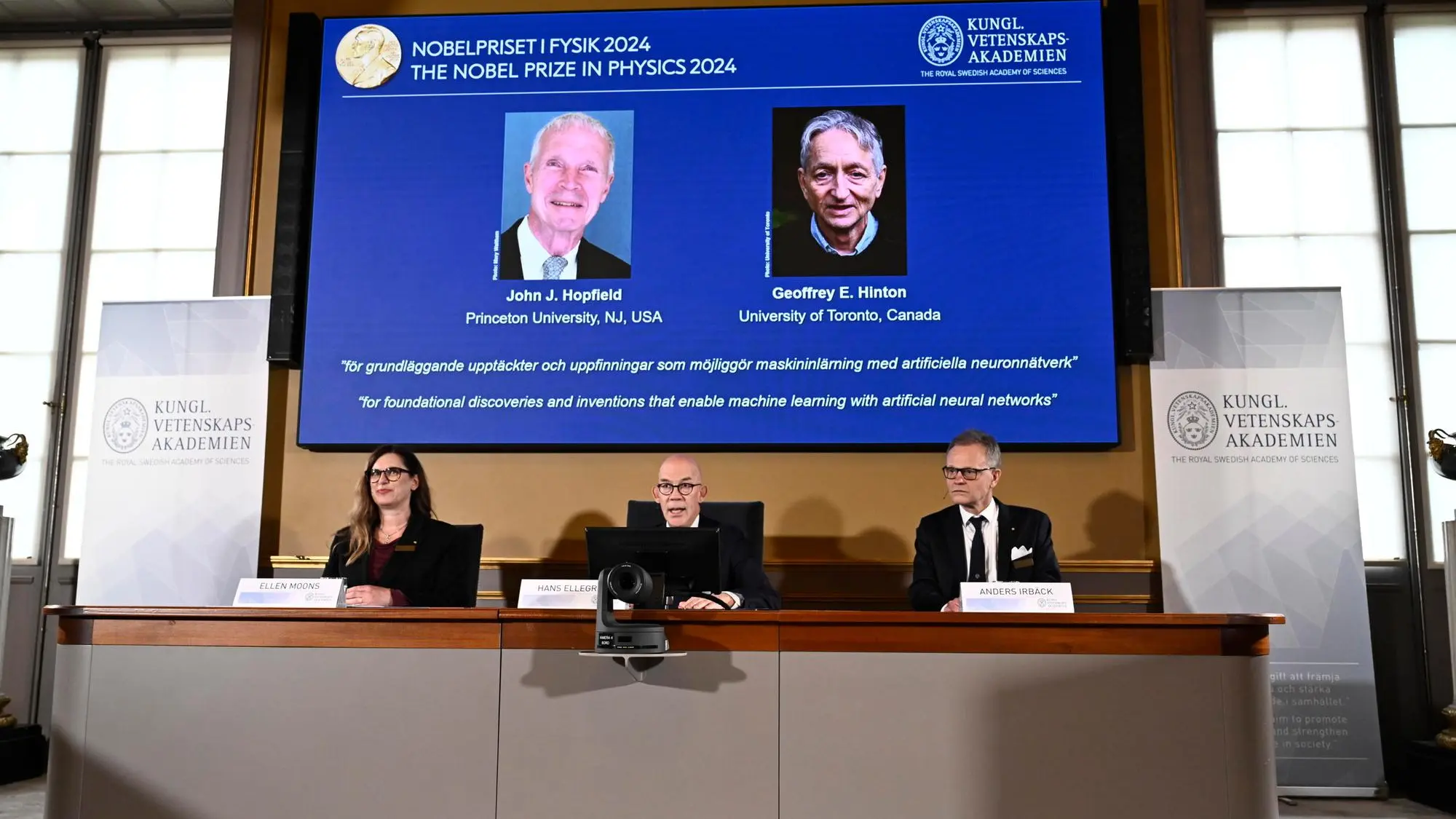


The 2024 Nobel Prize in Physics has been awarded to John Hopfield and Geoffrey E. Hinton , who pioneered the creation of neural networks and laid the foundations for machine learning and artificial intelligence.
The two, working independently, opened up a new and revolutionary field of research, which led to important developments , to the point of making artificial intelligence systems possible and revolutionizing both scientific research and everyday life.
"Hopfield – they explain in a note from Stockholm – created a structure that can store and reconstruct information. Hinton invented a method that can independently discover properties in data and that has become important for the large artificial neural networks in use today".
"Even though computers cannot think," the note continues, "machines can now imitate functions such as memory and learning. The 2024 Nobel Prize winners in physics have helped make this possible. Using fundamental concepts and methods of physics, they have developed technologies that use structures in networks to process information."
Thanks to the research conducted by Hopfield and Hinton, we have moved from traditional computer programs , based on clear and precise descriptions to generate results, to machine learning , in which the computer learns through examples and on this basis is able to tackle problems that are too vague and complex to be managed with specific instructions.
WHO I AM – The American John J. Hopfield (91 years old) has a long scientific career behind him, which ended at Princeton University . Born in the United States, in Chicago, in 1933, to a couple of Polish physicists, he graduated from Swarthmore College in 1954 and in 1958 he obtained a PhD in Physics at Cornell University. For two years he worked as a theoretician at Bell Laboratories, to which he remained linked for the next 35 years. He later taught Physics at the University of California and Berkeley, then at Princeton and then moved to the California Institute of Technology (Caltech), where in 1986 he was among the founders of the Calculus and Neural Systems program and where he taught Chemistry and Biology. He then returned to Princeton, where he taught Molecular Biology. Physics and biology were the points of reference for all his scientific production, up to the research on artificial neural networks