









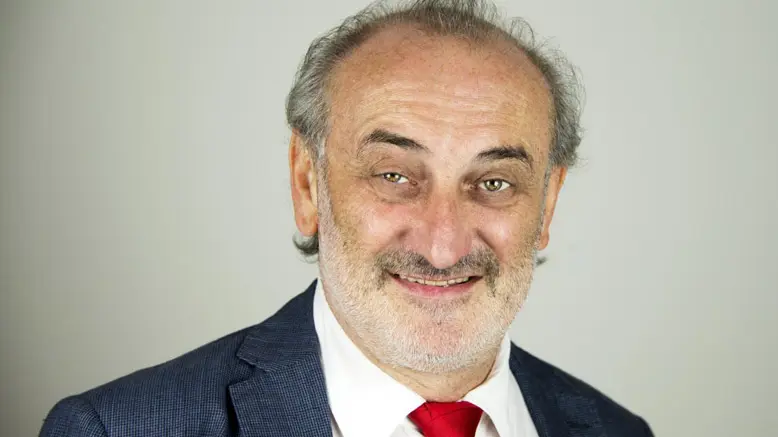





Educationalist Daniele Novara will be the featured speaker at a meeting dedicated to parenting and managing family conflict, including a presentation of his book "Mollami! Raising Adolescent Children and Finding the Right Distance to Help Them Grow."
The event is scheduled for Wednesday 22 October at 8.15pm at the Teatro di Sant'Eulalia , as part of the Love Sharing Festival.
Through concrete examples and nonviolent communication tools, Novara encourages parents and teachers to build relationships based on listening, autonomy, and mutual trust.
In your book "Mollami!", the central theme is the right distance between parents and adolescent children. What do you think is the most common mistake parents make today in their relationships with their children during this delicate stage?
We're talking about adolescents, that is, boys and girls who want to escape the maternal nest and the childish control of their parents to experience their own freedom. Parents, however, struggle to understand this transition from childhood to a new stage of life, and try to maintain the intimacy and closeness they once had, still viewing them as children. In this way, they pursue a pleasantness that no longer belongs to their children, who have now entered a completely different phase.
When you seek something that can no longer exist, difficulties and conflicts arise: children raise the bar of opposition, and disagreements become inevitable. However, they would be much more manageable if moms and dads understood that adolescence has entirely different needs than childhood.
The book's title is provocative. What's behind that "Mollami"? Is it a cry of rebellion or a plea for trust from the kids?
"Leave me" is a classic expression used by teenagers toward their parents. It's not just a word, but a communicative signal: it expresses the need to distance oneself in order to rediscover oneself, to distance oneself in order to build oneself. It's part of that repertoire of typical phrases—"You're the worst parents in the world," "When I'm 18, I'm leaving," "If you keep this up, I'll report you"—which, if read intelligently, shouldn't be scary. They're ways of defending one's autonomy.
Parents shouldn't take them literally, but they shouldn't abandon the issue either: at this age, children shouldn't be left alone or supervised like infants. They need to be supported, with an educational approach that respects their need for independence.
You emphasize conflict management as an educational opportunity. How can we help parents and teachers not fear conflict, but instead experience it as a natural part of growing up?
First of all, conflict is not war. Today, unfortunately, the term is often used as a synonym for violence, but its real meaning is "divergence," "contrariety," especially on a relational level.
The fragility of contemporary parents, immersed in a narcissistic era, lies precisely here: in their inability to tolerate their children's natural resistance, which is actually a healthy sign of autonomy and independence. In my book, I explain how to embrace this resistance, recognizing it as part of the growth process, not as a threat.
Adolescence is also a time of detachment and independence. How can adults learn to "let go" without feeling rejected?
In the book, I present various techniques developed from my thirty years of work with parents and teachers. One of the most effective is the "limit" technique: setting a limit within which the adolescent can exercise their freedom.
It could be a limit on time, money (the traditional allowance), or smartphone use, especially at night, which negatively impacts sleep and balance. These are "paternal" approaches, essential at this stage of life. At this age, lectures and insistence are no longer necessary: instead, a clear, coherent, and shared educational structure is needed.
The Love Sharing Festival combines pedagogy, ecology, and the culture of peace. How important is it today to educate about nonviolence, not only within families, but also as a social and community value?
I always carry a photo of Gandhi and his biography with me. I've based my career choices on a Gandhian inspiration: consistency between means and ends.
As Montessori would say, "the method is everything": before the content, it's the way we interact that counts. Yelling at a child to "be quiet" is a contradiction, just as hitting a child to teach him not to hit was once a contradiction.
Even in education, I've tried to maintain this consistency: it's no coincidence that I've written books like "Screaming Is Useless" and "Punishing Is Useless." Nonviolence is, first and foremost, an educational method based on communication and mutual listening.
So it's always a question of method?
Exactly. The method I developed for managing arguments between children, "Arguing Well," starts precisely from this: not by assigning blame, but by providing a space for discussion, where the two opponents can talk and listen to each other. Communication is the foundation of nonviolence: it means managing conflict constructively, transforming it into learning.
In your career as an educator, you've met thousands of families. Is there one episode or piece of advice that has taught you more than any other what it means to truly educate?
My goal has always been to help people unleash their own resources. For children, this means learning to do things on their own, to explore, to experience freedom.
When this doesn't happen, obstacles arise that are often labeled "disorders" today, but are actually simply educational difficulties. An important part of my work, also with Marta Versiglia, has been helping parents understand that behind a diagnostic label may simply be a developmental impediment.
Seeing those children—and then those young people—regain their balance and normalcy is one of my greatest thrills. Education, after all, is this: learning to always look at the glass half full, not half empty.