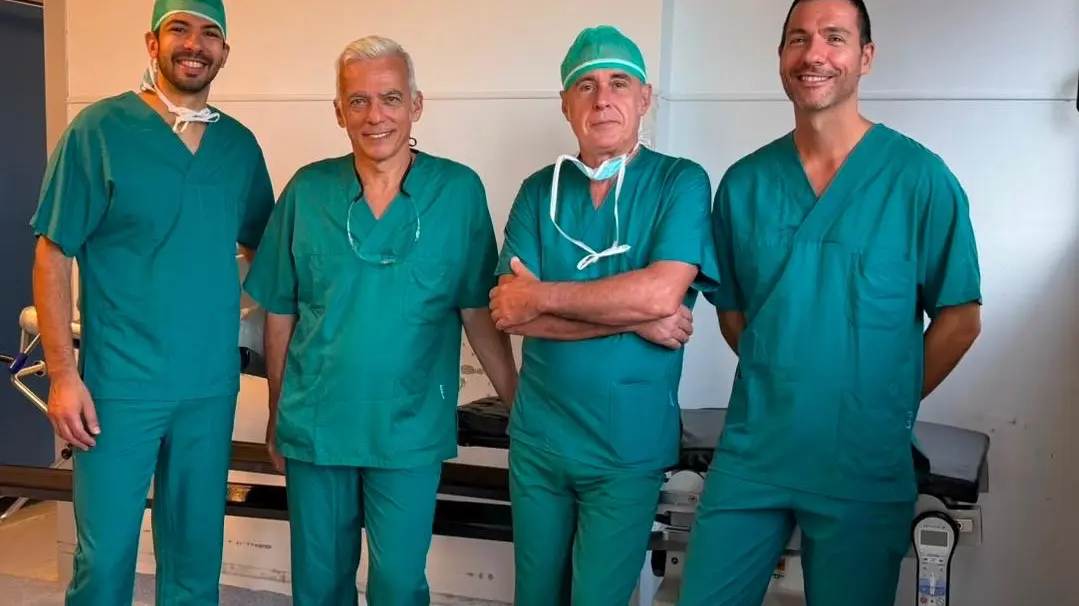


At Brotzu Hospital in Cagliari, one of the most complex hip replacement revision surgeries in Italy is underway: a custom-made 3D-printed implant restores independence to a patient. "This procedure confirms the level of excellence achieved by our national health service and the role of our hospital as a point of reference for highly complex orthopedic surgery," emphasizes Anas Brotzu General Manager Maurizio Marcias.
As stated in a press release, "There are procedures that represent a surgical challenge, while others, until a few years ago, would have been considered nearly impossible. This is the case with the revision hip replacement performed by the team at the Orthopedics and Traumatology Unit of Arnas Brotzu Hospital in Cagliari, led by Giuseppe Dessì, which restored mobility and independence to a 63-year-old patient thanks to the implantation of a completely customized acetabular component, designed based on his anatomical characteristics and manufactured using 3D printing technology."
The clinical history
The surgery was performed on June 6th at San Michele Hospital "on a patient with a particularly complex medical history. The man had undergone an initial left total hip replacement in France in 1985 and, subsequently, in 2000, a revision surgery due to the failure of the prosthesis. Over the years, the progressive loosening of the implant due to aseptic loosening had led to a severe loss of bone substance in the pelvis, resulting in a significant acetabular defect. This condition rendered traditional commercially available revision prostheses unusable and required a completely customized solution."
The planning
After an in-depth clinical and radiological study, Giuseppe Dessì and his team planned a highly specialized procedure, based on the design of a custom-made acetabular implant, developed exclusively for the patient's anatomical characteristics. The procedure, as explained in the statement, involved the removal of the loosened prosthesis, reconstruction of the severe bone defect using a bone graft, and subsequent implantation of the customized component, allowing for the stable reconstruction of the joint and the restoration of the correct hip rotation center. The collaboration with Permedica, an Italian company specializing in the development of high-tech orthopedic devices, was crucial. The bioengineers worked closely with the surgical team to design the implant, which was made of titanium alloy using additive manufacturing (3D printing) and features a highly osseointegrative surface achieved using patented Traser® technology, which promotes biological integration with the residual bone. Planning was also supported by the creation of a full-scale three-dimensional model of the pelvis and implant, used to pre-emptively simulate the procedure and precisely define the positioning of the fixation screws according to trajectories studied on the three-dimensional reconstruction of the pelvis.