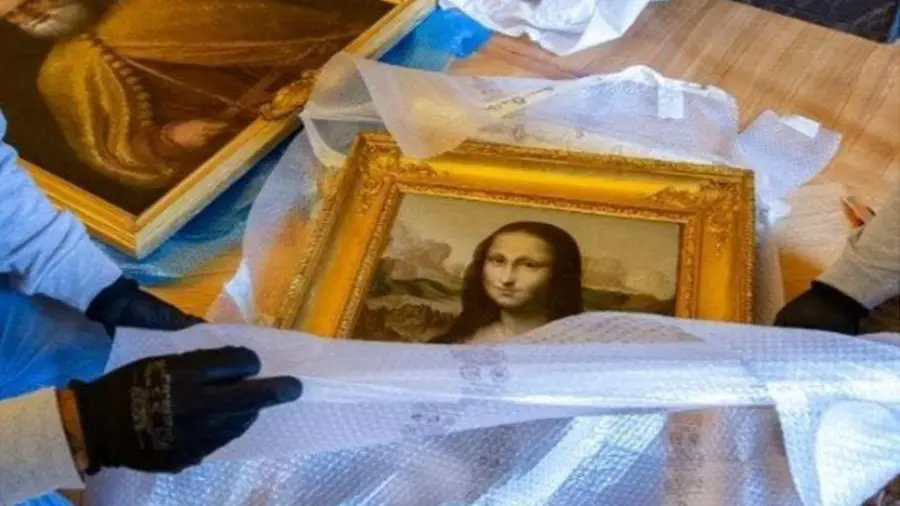


The news of a second “Gioconda”, a copy of the one in the Louvre, kept in Rome, in deposit in Montecitorio, where it arrived in 1925 from the museum of ancient art of Palazzo Barberini, causes scholars to discuss.
According to the commissioner of the Chamber, Francesco D'Uva, it would be a work of particular value, who deprived himself of it to exhibit it in the Aldo Moro room in Montecitorio: "It is a copy of the painting in the Louvre made by Leonardo's workshop, perhaps even with his own collaboration "says the parliamentarian.
The analyzes made during a recent restoration of the canvas would have confirmed its dating in the first half of the sixteenth century (Leonardo died in 1519). Originally on wood, like the original exhibited in the Louvre, the Roman Mona Lisa belonged to the Torlonia family.
OPINIONS - On the value of the work, however, the experts are divided: the art historians Antonio and Maria Forcellino, in a contribution to the catalog of a Roman exhibition on Leonardo that was held in 2019, underlined its quality. According to them, certain features of the landscape and the veiling of the skin tones "are of a transparency that accurately echoes Leonardo's executive technique in the Louvre painting", indeed, "the pictorial technique ... is so refined as to suggest that Leonardo himself put his hand to the chiaroscuro definition of the face ".
The art historian Rossella Vodret, former superintendent of Rome, had instead filed the painting in 2005 defining it as "not of high quality". Another art historian and former superintendent of Rome, Claudio Strinati, stands equidistant: "Forcellino's opinion is legitimate" and it is also plausible that it is a work from Leonardo's workshop. But as for the fact that there is the hand of the master, "in my opinion it is a painting of medium quality that does not seem to denote the imprint of an excellent hand like that of Leonardo".
"Not at all second Gioconda", the lapidary comment by Vittorio Sgarbi, "that is a modest canvas". Not a masterpiece, therefore according to the art critic, but "if anything, a modest decorative painting".